
Cantharellus pallens
Taxonomy
Main synonym
Common names
Seta amarilla, rebozuelo, zizahori, rosignol.
Geographic references:
Interactive map with data from GBIF.





Morphological Features:
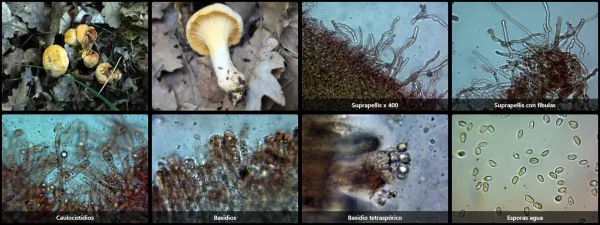
Pileus 5 to 10 cm in diameter, plano-convex when young, later becoming depressed in the center, eventually becoming infundibuliform with age. Apparently white in color due to a whitish pruinose coating, though the underlying ground color is orange-yellow, which becomes visible upon scratching with a fingernail to remove the pruina. Margin irregularly lobed.
Lamellae (actually a type of folds), markedly forked, orange-yellow like the pileus. Highly decurrent on the stipe.
Stipe rather short, cylindrical or attenuated at the base, solid and full, similar in color to the remaining parts. Sometimes also pruinose.
Flesh thick, especially in the center of the pileus, thinner at the margin, yellowish in color, with a very pleasant fruity odor and a slightly peppery taste.
Habitat:
Found in highly diverse habitats, including beech forests, pine woods, holm oak woodlands, and even under rockroses. A species fruiting from late spring to early autumn. Locally frequent and abundant.
Observations:
Despite a slight peppery bite in the raw flesh, it is a mushroom with broad culinary versatility, used in preparations ranging from salads to desserts. Recently separated from Cantharellus cibarius, a related species lacking pruina and exhibiting several varieties (see corresponding entry). Notably resembles Cantharellus friesii, which is smaller and butter-yellow in color, also edible. Dangerous confusion may occur with Omphalotus olearius, a lignicolous species with an elongated stipe and true lamellae.