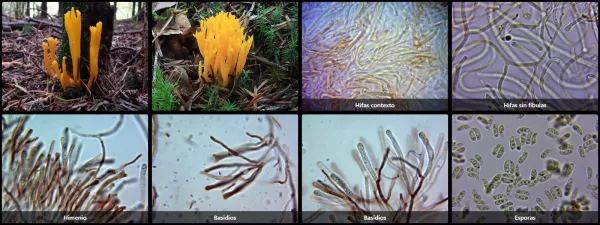
Calocera viscosa
Taxonomy
Main synonym
Common names
Calocera viscosa, mukiadar luze.
Geographic references:
Interactive map with data from GBIF.




Morphological Features:
Basidiocarp branched or coralloid in shape, resembling that of Ramarias, reaching a height of 6 to 7 cm, occasionally slightly more, with each branch measuring only a few millimeters in thickness. The branch tips are forked and sometimes even trifid, generally acute but occasionally more rounded. Its surface is intensely orange-yellow, but darkens to a reddish-orange upon drying; it is also highly viscid in wet weather and glossy even when drier.
Hymenium smooth, immersed in the outer surface of the basidiocarp.
Stipe absent as such, though it possesses a whitish extension, often subterranean, that attaches it to the substrate.
Flesh yellow in color with a gelatinous consistency, quite tough, becoming harder upon drying. Neither its odor nor taste is remarkable.
Habitat:
Although its occurrence under broadleaf trees cannot be ruled out, it is fundamentally a species associated with conifers, where it fruits on their dead wood. It is a frequent species in its habitat and can be found practically year-round.
Observations:
This species is frequently confused with yellow Ramarias, such as Ramaria flava or Ramaria aurea. For accurate differentiation, one must consider the elastic, tough, and gelatinous consistency of its flesh, which lacks the typical fragility of Ramarias. Calocera cornea, a broadleaf-associated species, differs by its solitary fruiting habit and smaller size.