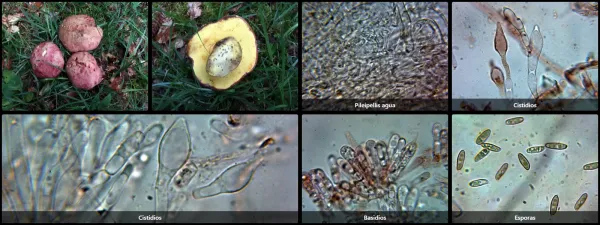

Butyriboletus regius
Taxonomy
Main synonym
Common names
Boleto real, onddo errege.
Geographic references:
Interactive map with data from GBIF.

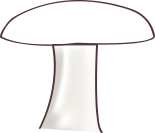


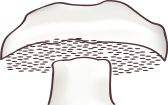
Morphological Features:
Pileus medium-sized for the genus, 10 to 15 cm in diameter when mature. Changes from hemispherical to convex, eventually flattening with age. Strikingly beautiful pink in color, occasionally somewhat faded. The cuticle is separable and may crack in dry conditions; it is also smooth and dry. Margin slightly excurrent and regular.
Tubes not too long, narrow, and adnate; distinctly bright yellow in color, except in mature specimens which turn olive. Remain invariable both when cut and when bruised.
Pores chrome yellow, matching the color of the tubes; round or sometimes angular. Like the tubes, they remain invariable when cut or bruised.
Stipe relatively short, broader at the base and tapering towards the pileus; yellow throughout its surface, bearing a fine, concolorous reticulation on the upper portion.
Flesh yellow throughout, perhaps slightly pinkish at the base and reddish beneath the cuticle; solid, thick, and firm. Odor mild and pleasant; taste similarly agreeable, reminiscent of nuts.
Habitat:
Exclusive to broadleaf trees such as oaks or beeches, fruiting from late spring to early autumn. While known to occur abundantly in certain regions, it is extremely rare in the northern part of the Iberian Peninsula.
Observations:
Choice edible, with a fine and delicate flavor, highly recommended. It closely resembles Butyriboletus pseudoregius, a species with a somewhat redder pileus that typically bears a reddish annular zone on the stipe. The main difference between the two species is the bluing of the flesh in the latter; nevertheless, it is equally edible.