
Bulgaria inquinans
Taxonomy
Main synonym
Common names
Bulgaria tiznada, Bulgaria negra, mukibotoi beltz.
Geographic references:
Interactive map with data from GBIF.





Morphological Features:
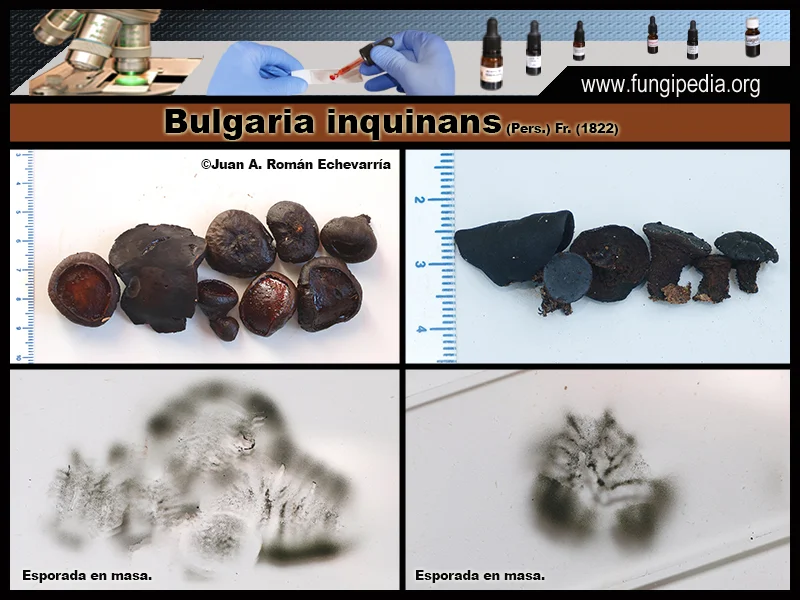
Fruiting body of somewhat variable shape; in its initial stage it is more or less convex, potentially adopting a spherical form as it grows upward. In typical specimens, the upper surface is flattened, resembling a bath plug, although many individuals are quite amorphous. It is divided into two color-differentiated zones: the outer portion is pruinose and distinctly brown. Fully developed specimens may reach up to 4 cm in diameter.
Hymenium, or fertile region of the fruiting body, located on the inner surface; smooth and flattened at maturity, black in color.
Stipe practically absent; typically sessile, adhering directly to the substrate.
Flesh gelatinous, brownish in color, and tenacious in consistency. Odor and taste are barely perceptible.
Habitat:
A fairly frequent and abundant species, fruiting from summer through autumn. Occurs on fallen trunks and branches of broadleaf trees, occasionally forming extensive colonies.
Observations:
A distinctive species within its genus, characterized by flattened black fruiting bodies, a habitat on fallen logs or branches, and a gelatinous flesh that becomes leathery upon drying. We consider it relatively easy to identify; however, older specimens may be confused with certain Exidia species, such as Exidia glandulosa or Exidia truncata, which do not belong to this genus.
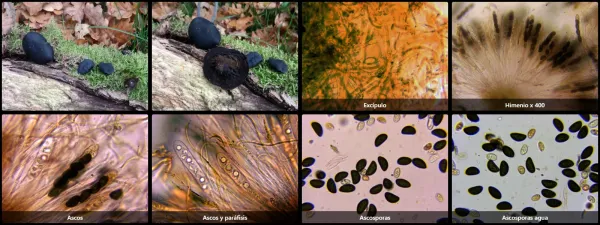
Microscopy of Bulgaria inquinans