

Xerocomus subtomentosus
Taxonomy
Main synonym
Common names
Boleto subtomentoso, onddo bigun.
Geographic references:
Interactive map with data from GBIF.



Morphological Features:
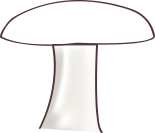
Pileus of medium size, can reach up to 10 cm in diameter, hemispherical in its early stage, becoming convex and later nearly completely flattened. Surface distinctly velvety, ochre in color, with tones that sometimes approach brownish shades, while at other times are closer to yellow. During dry periods it may crack, but is never separable from the flesh. Margin slightly excurrent and quite regular.
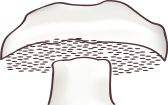
Tubes adnate and quite long, yellow in color, generally unchanging when cut.
Pores medium-sized, polygonal, yellow in color, but turning olivaceous with age. Upon rubbing they sometimes blue weakly, but normally only darken.
Stipe generally thick and ventricose, rather than cylindrical, but in any case attenuated at the base. It is yellowish-ochre in color with brown pustules, occasionally rugulose, and may even exhibit irregular longitudinal ridges along portions of its length.
Flesh white in the pileus and pale yellow in the stipe, spongy but firmer than that of other allied Xerocomus species. It typically does not blue when cut, although it occasionally does so weakly. Odor mild and fruity; taste mild.
Habitat:
It fruits preferentially in broadleaf forests, although its occurrence under conifers cannot be ruled out. It appears in summer and throughout autumn. It is a frequent mushroom, even abundant in some years.
Observations:
Despite not being highly prized, this mushroom is edible. Regarding possible confusions, we must highlight Boletus ferrugineus, which has a reddish-brown pileus and is often confused with this species; it differs in having a yellow mycelial base rather than white. It is not easily confused with toxic species.