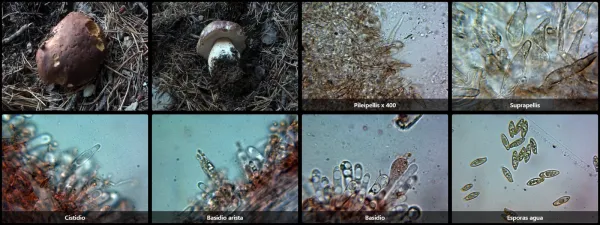

Boletus pinophilus
Taxonomy
Main synonym
Common names
Boleto de pino, kaskabeltz, cep vermellós, cep rogent.
Geographic references:
Interactive map with data from GBIF.



Morphological Features:
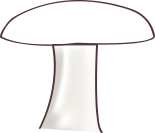
Pileus large and fleshy; specimens exceeding 20 cm in diameter are common. Hemispherical for much of its development, later becoming plano-convex. Exhibits some color variability but consistently displays reddish hues or its characteristic mahogany tone. The surface is smooth and dry, becoming somewhat glossy when wet, though barely viscid; it is difficult to separate from the pileal flesh. Margin regular, tending to overhang in older specimens.
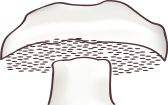
Tubes elongate, adnate; initially white, later turning yellowish, and finally olive. Quite crowded and remaining unchanging in color both when cut and upon bruising.
Pores similarly crowded and round, but of uneven size; their color development mirrors that of the tubes, remaining unchanging upon rubbing.
Stipe ventricose when young, somewhat more elongate in mature specimens; it may occasionally exceed the pileus in diameter. Ground color is whitish or yellowish, but spotted or reticulate with red, sometimes entirely; in older specimens it tends to become somewhat more ochraceous. Notably fleshy in appearance.
Flesh thick and firm, very dense; white except beneath the cuticle, where it is slightly reddish. Odor is highly pleasant, and flavor is equally agreeable.
Habitat:
Although its name associates it exclusively with pines, it also fruits under beeches or oaks, producing an initial flush in spring and reappearing in autumn. It is particularly abundant in some areas but scarce in others, although it is widely distributed throughout the Iberian Peninsula.
Observations:
It is a highly prized choice edible which, along with edulis, aereus and reticulatus, constitutes the group of large edible boletes commonly known as ceps or porcini. It is frequently confused with the black bolete, Boletus aereus, which never exhibits those mahogany tones on the pileus, being much more bronzed. Butyriboletus regius is more pinkish, and its pores are never white.