

Boletus ferrugineus
Taxonomy
Main synonym
Common names
Not available
Geographic references:
Interactive map with data from GBIF.
Morphological Features:
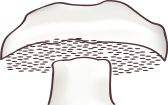
Pileus which at full maturity can slightly exceed 10 cm in diameter, hemispherical in its early stage, then convex, eventually becoming almost completely flattened. It is more or less dark brown with a reddish tinge, though by no means red nor does it exhibit olive tones. Its surface is markedly tomentose, especially when young, and difficult to separate from the pileal flesh. Margin slightly overhanging and not incurved.
Tubes rather fine and elongated, yellow in color, turning more olive-toned with age. Completely free from the stipe, extending to form a circle around it.
Pores concolorous with the tubes, broad and irregular, staining blue upon handling, though not markedly.
Stipe slender and elongated, frequently curved, ochre in color with a yellowish tinge, usually ribbed but faintly so, with the ribs most often only visible in the upper portion.
Flesh not particularly firm, rather soft in the pileus and fibrous in the stipe, as is typical for most former Xerocomus species. Stains blue upon cutting sporadically, as the coloration quickly fades again. Its odor is barely perceptible and its taste sweet and mild.
Habitat:
This species is found under both broadleaf trees and conifers, with autumn being its preferred fruiting season. It is not a mushroom that can be considered common, and it is becoming increasingly rare.
Observations:
It is a mediocre edible closely resembling Boletus subtomentosus, which some authors consider to be a variety of; however, we regard it as a distinct species. Having held both side-by-side, the difference is noticeable, particularly in the color of the mycelial base, which is yellow for this species and white in the subtomentosus. It also resembles Rheubarbariboletus armeniacus, which has a much redder cuticle.