

Boletus erythropus
Taxonomy
Main synonym
Common names
Pie rojo, onddo hankagorri, mataparent de peu vermell.
Geographic references:
Interactive map with data from GBIF.




Morphological Features:
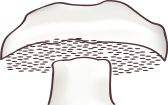
Pileus 5 to 15 cm in diameter, occasionally slightly larger, initially hemispherical, becoming convex and finally plano-convex. Although it may sporadically exhibit reddish tinges, it is dark brown or chestnut-brown in color; its cuticle is velvety in immature specimens, later becoming dry and tomentose. The margin is typically overhanging.
Tubes yellowish in color, quite numerous and therefore closely spaced, turning blue when cut. They separate easily from the pileal flesh.
Pores crimson in young specimens, quickly becoming red, round, and not overly large, staining blue conspicuously upon the slightest pressure.
Stipe thick, ventricose when young, but elongating with age; typically narrower at the junction with the pileus. Yellowish background color, though dotted over its entire surface with bright red, which ultimately becomes the prevailing color. Lacks a reticulum.
Flesh of a striking yellowish-green color, staining intensely blue upon cutting. It is thick and firm, and softer in the pileus than in the stipe. It has a very mild, barely perceptible odor and a slightly sweet taste.
Habitat:
It can be found from as early as May until well into autumn. It is a very common and abundant species that fruits equally under pines and deciduous trees.
Observations:
It is a good edible that is usually overlooked; we have found it cut and discarded on numerous occasions. Its culinary yield is very high, as it is rarely attacked by insect larvae. It may be confused with Suillellus luridus, which has a reticulate stipe, as well as with Suillellus queletii, which has a yellow stipe with a vinous-red base. The toxic species Suillellus satanas is paler and stains blue more weakly.
