
Boletopsis leucomelaena
Taxonomy
Main synonym
Common names
Poliporo blanquinegro, onddo-ardagai beltz.
Geographic references:
Interactive map with data from GBIF.


Morphological Features:
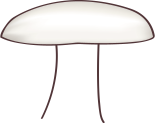
Pileus reaching up to 15 cm in diameter at full development, typically 8 to 12 cm in most cases; initially hemispherical, evolving into somewhat irregularly convex shapes. Fundamentally gray but exhibiting various shades, occasionally including brownish or violaceous tints. Surface fibrillose and dry-appearing, cracking under drought conditions. The margin is initially more regular but becomes irregularly undulate and lobed over time.
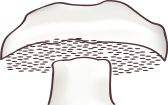
Tubes very short, dirty white when young, turning gray with age; decurrent on the stipe and practically inseparable from the pileal flesh.
Pores medium-sized, 2 to 3 per mm, identical in color to the tubes. Initially homogeneous and rounded, becoming angular and irregular with age.
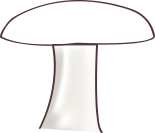
Stipe central or slightly eccentric, thick and robust, solid; generally cylindrical but sometimes attenuated at the base with a rooting tendency. Its length is shorter than the pileus diameter, and its color is similar to that of the cap.
Flesh thick and compact, whitish in color, quite firm; upon cutting, it initially turns pinkish, later becoming grayish. Odor faint or indistinct; taste markedly bitter.
Habitat:
A rare species that fruits solitarily or at most in pairs, terrestrial. Fruiting occurs in spring and autumn, and it has consistently been located in pine forests.
Observations:
This species is of interest due to its scarcity and difficulty in locating specimens, as well as its challenging taxonomic placement, as it is neither a bolete nor a polypore in the strict sense. By color, it may resemble Tylopilus porphyrosporus, but that species is a true bolete with tubes separable from the flesh and considerably longer. It is entirely inedible due to two factors: its bitter flesh and its firm texture. Boletopsis grisea is less robust and less fibrillose, but we strongly suspect it represents variants of the same species.