Baeospora myosura
Taxonomy
Main synonym
Common names
Colibia de las piñas, pinotxa kolibia.
Geographic references:
Interactive map with data from GBIF.




Morphological Features:
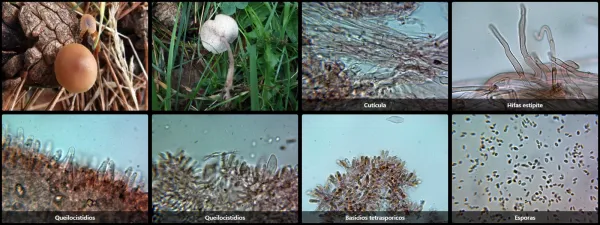
Pileus very small, reaching at most 2 cm in diameter, initially convex becoming plano-convex or even expanded, retaining an obtuse umbo in the central area. Precisely this umbonate zone is a darker ochre than the rest, which is also ochre but fading, especially towards the margin. Its surface is smooth and slightly viscid in wet weather, and its margin is not striate despite being somewhat hygrophanous.
Lamellae adnate, whitish in color, becoming cream at maturity, narrow and very crowded.
Stipe cylindrical and elongated, rigid and tough, similar in color to the pileus or somewhat paler. It appears slightly radicate at the base, where it bears whitish rhizoids, sometimes not apparent when the stipe is deeply embedded in the substrate.
Flesh scant and somewhat soft, white in color. Odor and taste faint, mild.
Habitat:
Generally grows in gregarious clusters on cones of various pine species; it is frequently found on exposed cones, not necessarily on buried or semi-buried ones. It is a frequent and fairly abundant species that fruits during autumn.
Observations:
Several other species fruit on pine cones besides the one described here, such as Mycena seynesii, which otherwise has a completely different appearance. Species of Strobilurus may bear some resemblance; these are spring-fruiting taxa that always grow on buried cones. There is a spring form classified as Collybia conigena, currently named Strobilurus conigenus, which possesses capitate cystidia and non-amyloid spores.