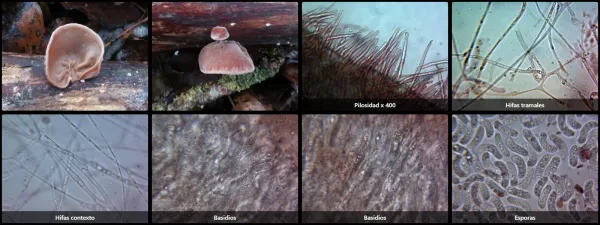

Auricularia auricula-judae
Taxonomy
Main synonym
Common names
Oreja de Judas, Judasen belarri, orella de Judas.
Geographic references:
Interactive map with data from GBIF.




Morphological Features:
Fruiting body typically ear-shaped, although it may adopt somewhat variable irregular forms, ranging from an open cup shape to occasionally becoming deformed. Its size varies considerably, with specimens reaching 10 cm in diameter found alongside perfectly developed ones of only 3 cm. The external surface is sterile, dark brown in color, sometimes with an olive tint. It may be somewhat veined or smooth, slightly pubescent or tomentose, and translucent.
Hymenium ranging from smooth in its early stage to folded or veined; brown in color, gradually shifting to purplish tones, and finally becoming nearly black.
Stipe inconspicuous, absent in most cases; when present, it is entirely lateral.
Flesh elastic in consistency, even gelatinous, especially when young; with little to no odor and a mild flavor.
Habitat:
This fungus may fruit at any time of the year, even in winter, and is always found on stumps or fallen logs of broadleaf trees.
Observations:
Despite its unappealing appearance, it is an edible fungus and is even consumed raw in salads. It may be confused with Auricularia mesenterica, which generally has a zoned upper surface and more distinct hairs. A smaller species with which it may also be confused is Auriculariopsis ampla=Schizophyllum amplum, commonly found on fallen poplar branches, which is microscopically completely different, as it does not belong to the same genus or even class. Tremella foliacea has a similar color but lacks veining on the hymenium.