
Asterophora parasitica
Taxonomy
Main synonym
Common names
Not available
Geographic references:
Interactive map with data from GBIF.


Morphological Features:
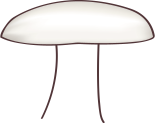
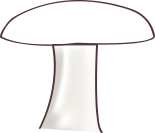
Pileus of minute dimensions, reaching at most 2 cm in diameter, though typically around 1 cm; globose at emergence, subsequently becoming hemispherical to convex, never expanding to flat. White in color, with a surface covered by a floury, creamy-white powdery coating. Sterile, as is typical for standard mushrooms.
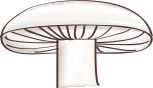
Lamellae whitish to cream-colored, rather widely spaced with intervening lamellulae. Unlike in Asterophora lycoperdoides, these are not sterile, as the chlamydospores develop within the lamellar trama, rather than on the pileus. These chlamydospores are stellate, befitting the genus name, but smooth.
Stipe generally longer than the pileus diameter, white, cylindrical.
Flesh scant and soft, white in color, with a floury odor that turns nauseating due to the decay of the host mushroom it parasitizes.
Habitat:
A parasitic species that always fruits on Russulas of section compactae, developing its mycelium upon the decaying tissue of the host Russula; in this case, the photographed specimens were found on Russula nigricans. A species fruiting in summer and autumn. It is uncommon.
Observations:
A small parasitic species of blackening Russula mushrooms. Asterophora lycoperdoides is much more common, fruiting under the same conditions, season, and habitat, but it has a shorter stipe and its pileus is covered with a brownish powdery coating; furthermore, its chlamydospores are pyramidal and develop on the pileal surface, rather than within the lamellar trama as in this species. Regarding edibility, it is evident that they possess no culinary value.