
Asterophora lycoperdoides
Taxonomy
Main synonym
Common names
Not available
Geographic references:
Interactive map with data from GBIF.


Morphological Features:
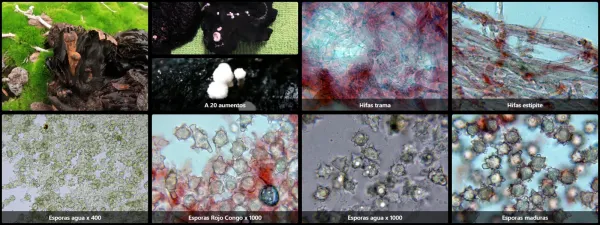
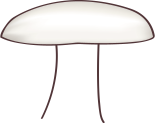
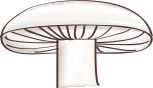
Pileus small-sized, reaching at most 2 cm in diameter, though typically around 1 cm; initially hemispherical, later convex, never flattening. The underlying color is whitish, but it appears brownish due to a covering of mealy powder of the same hue, which consists entirely of spores referred to here as chlamydospores. These, as the specific epithet implies, are stellate and pyramidal in this case, developing directly on the pileal surface.
Lamellae well-spaced, interspersed with lamellulae, pale cream to whitish in color, and sterile.
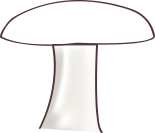
Stipe cylindrical and generally short, fairly well-proportioned relative to the pileus, white in color.
Flesh scanty, soft-textured, white, with a putrid odor that hardly invites tasting.
Habitat:
It is a parasitic species that utilizes the decaying tissue of certain Russulas as a substrate upon which it fruits. We have consistently observed it on Russulas of section compactae, the so-called blackening ones, and in this specific instance on Russula densifolia. It is encountered annually without difficulty, indicating that it is a frequent species.
Observations:
It is a small parasitic species of Russulas notable for the presence of sterile lamellae and a fertile pileal surface where stellate chlamydospores develop. It closely resembles Asterophora parasitica, which is white, lacks the brownish powder, and possesses smooth rather than pyramidal chlamydospores.