
Ascotremella faginea
Taxonomy
Main synonym
Common names
Not available
Geographic references:
Interactive map with data from GBIF.
Morphological Features:
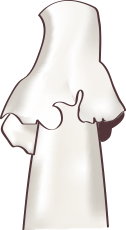
Ascocarp with a lobulate or cerebriform shape; when young they appear to have a tendency to form almost individually, but in reality over time they coalesce into a single entity, a compact gelatinous mass. It usually exhibits variable size, frequently exceeding 5 cm in length, 2 to 3 cm in width, and reaching a height of 2 to 3 cm. When fresh, it has a characteristic reddish-brown color, but with age it loses the reddish component and becomes distinctly brown.
Hymenium covering the entire external surface of the ascocarp, identical in color to the rest of it, smooth and glabrous. Produces rather ellipsoid ascospores that are apically pointed, with faint striations.
Stipe absent; it is a sessile species that adheres directly to the substrate.
Flesh concolorous, very gelatinous in consistency, becoming mucilaginous and unpleasant when old; broad flesh without internal cavities, thus compact. It has barely any odor when young and its taste is indistinct, although it is difficult to sample due to its unappealing appearance.
Habitat:
Ascotremella faginea is a species that fruits by bursting through the bark of wood on fallen trees or stumps, generally on dead broadleaf wood, although we note a clear predilection for beech wood (Fagus sylvatica). It forms sometimes extensive masses, appearing from summer onwards, but primarily during autumn. It is not an overly frequent species.
Observations:
When encountering this species, one might initially mistake it for a Tremella based on its macroscopic characters; however, it is an Ascomycete. Another Ascomycete with which it could be confused is Neobulgaria pura, which in its variety foliacea adopts similar forms, but upon closer inspection, one will see that it consists of clustered individuals rather than a homogeneous mass. Tremella foliacea has a similar color, is more lobulate, and contains basidia, not asci.