Ascocoryne sarcoides
Taxonomy
Main synonym
Common names
Mukizia ubel.
Geographic references:
Interactive map with data from GBIF.




Morphological Features:
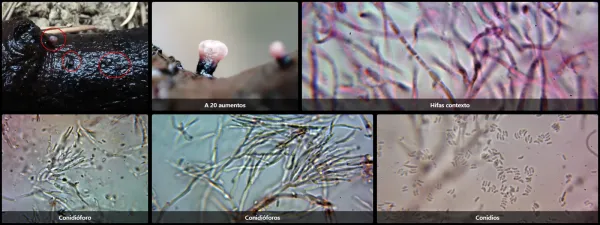
Fruiting bodies exhibit varying shapes depending on their developmental phase. In the conidial phase, they appear as erect, club-shaped structures bearing simple, lens-shaped conidia. The most well-known and typical primary form consists of gelatinous, cerebriform, or irregularly lobed aggregations, occasionally adopting other diverse shapes. In both phases, the entire structure is characterized by a uniform pale pink or lilac coloration; only when old do they become dull and purplish-brown.
Hymenium composed of asci containing largely septate spores, with up to 3 septa per spore, although not all are septate. Spore size varies considerably, potentially reaching approximately 20 µm by 4–5 µm.
Flesh pink in color with a gelatinous consistency; it lacks a distinctive odor and has a mild taste.
Habitat:
This species should be considered relatively frequent, fruiting on dead wood, stumps, or branches of broadleaf trees, with a preference for beech or oak. It typically appears with the onset of cold weather, during late autumn and even into winter.
Observations:
The conidial form, also referred to as the anamorph, of this species is regarded by various authors as a distinct entity under the name Coryne dubia. However, there exists a species that is macroscopically nearly identical to this one, Ascocoryne cylichnium, which features larger and much more heavily septate spores, with some possessing up to 7 septa; furthermore, its paraphyses are filiform with an apical thickening.