Ascocoryne cylichnium
Taxonomy
Main synonym
Common names
Not available
Geographic references:
Interactive map with data from GBIF.





Morphological Features:
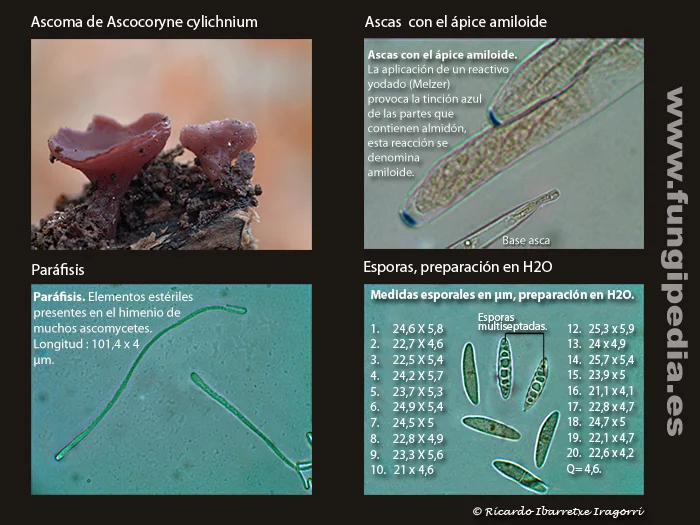
Fruiting bodies sub-sessile or with the presence of a stipe immersed in the substrate. They exhibit a striking violet color when young, later turning purple with a crimson tinge. In their initial stage, they are button-shaped or discoid; subsequently, the margin elevates, adopting a more or less dome-shaped form, and finally becomes irregularly lobed or undulate. As they typically grow in clusters, it is not uncommon for them to coalesce and form folds.
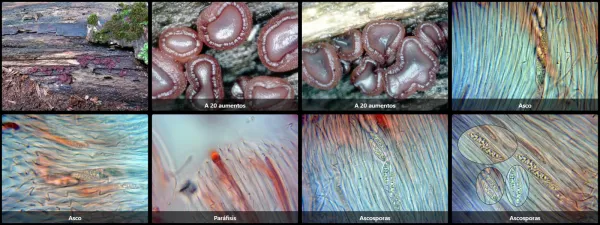
Hymenium smooth and concolorous, becoming wrinkled upon reaching maturity. It bears asci that produce ellipsoid ascospores which become multiseptate at maturity.
Stipe evident in most cases, either as a simple extension of the pileus into the substrate or even as a true stipe; however, it is most often embedded in the substrate and may go unnoticed. It usually shares the same color as the rest of the ascocarp and gradually fades toward the base.
Flesh gelatinous in consistency and practically identical in color to the external surface. Its taste is bland, and it lacks a readily perceptible odor.
Habitat:
It has been found on a fallen beech log (Fagus sylvatica), which, incidentally, is its preferred habitat, although it may also fruit on decaying wood of other broadleaf trees. It is a fungus that fruits in late autumn and throughout winter, being quite rare.
Observations:
This fungus bears a striking resemblance to Ascocoryne sarcoides, to the extent that macroscopic differentiation is very difficult, especially in mature specimens, although the latter does not assume a dome-shaped form. The most pronounced differences are microscopic: the species described here possesses larger spores that become multiseptate upon maturity, and its paraphyses are filiform and unbranched, unlike those of Ascocoryne sarcoides. Coryne dubia is a more branched conidial form of Ascocoryne.
Microscopy of Ascocoryne cylichnium