
Arrhenia spathulata
Taxonomy
Main synonym
Common names
Seta con forma de espatula
Geographic references:
Interactive map with data from GBIF.



Morphological Features:
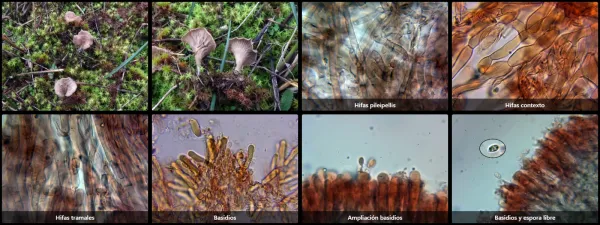
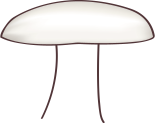
Pileus of reduced dimensions, the diameter of this species ranges from 5 to 20 mm, with a rather heterogeneous shape throughout its development, flabelliform or with a depressed center, typically spatulate overall. Cuticle with a dry appearance and slightly felted in young specimens, later completely glabrous, of variable color, ochraceous when young and hydrated, or more typically grayish to very pale gray upon drying, usually concentrically zoned. Margin regular in young individuals and markedly lobulate in adults.
Lamellae plicate, more like folds than true lamellae, poorly developed in some specimens, especially young ones, and in most well-patent and anastomosing, gray in color similar to that of the pileus, generally showing a fairly decurrent attachment on the stipe.
Stipe rudimentary and very short, eccentric or more commonly lateral, sometimes appearing as a mere extension of the pileus, in color similar to the rest of the basidiocarp and somewhat tomentose, especially at the base.
Flesh practically imperceptible; this is a species of minimal stature, nor are any noteworthy odor or taste detected, being completely tasteless.
Habitat:
We are undoubtedly dealing with a clearly bryophilous species, fruiting on mosses of various genera, not exclusive to any particular type of moss. It may go unnoticed due to its small size but is by no means a rare species, rather quite frequent; it typically fruits in groups, rarely solitary, on the mosses carpeting forest floors, being very abundant on Tortula sp. in coastal areas. It may appear at any time of year if climatic conditions are favorable; in fact, in coastal areas it is more frequent in winter.
Observations:
This small-sized species is relatively easy to recognize macroscopically; it is characterized by its flabelliform pileus, the spatulate shape of its basidiocarp, with a rudimentary eccentric stipe, its anastomosing plicate lamellae, and its habitat on diverse mosses. The species it most closely resembles is Arrhenia lobata, a species of gelatinous consistency more typical of mountain bogs; it may also be confused with moss-parasitic species of the genus Rimbachia, which are even smaller and lack such evident folds in the hymenium.