
Arcyria denudata
Taxonomy
Main synonym
Common names
Not available
Geographic references:
Interactive map with data from GBIF.
Morphological Features:
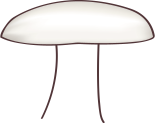
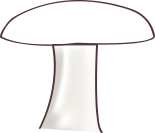
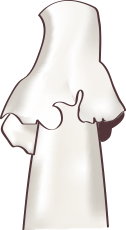
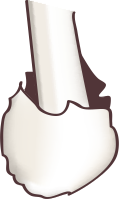
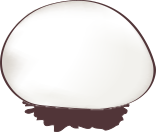
Sporophore erect, growing individually but gregariously, reaching a height of barely 2 to 3 mm. Its development originates from the slime of a white plasmodium that forms the hypothallus, which aggregates into small protuberances adopting a reddish hue. Its myxogasteroid development causes a stipe to rise, which may retain its reddish color or turn brown and is solid. At the apex of this stipe, the fertile head develops, initially globose but rapidly elongating to an ovoid shape; this head houses the spores and capillitium internally. Upon rupture of the smooth outer covering or peridium, the capillitium is released; it is always very abundant and may appear pinkish, reddish, or ultimately brown with a reddish tint. This capillitium consists of fibers with half-rings highlighted in a spiral pattern, 3 to 4 micrometers in diameter, which are not very homogeneous and give way to more warty areas; viewed laterally, they appear as crested fibers. It always exhibits at the junction between the stipe and fertile head a funnel-shaped, slightly reticulate calicle to which the capillitium is attached.
Spores reddish-brown in mass, more or less rounded, with a diameter of 6 to 9 micrometers. They bear fine, irregularly arranged or scattered warts.
Habitat:
A Myxomycete that fruits exclusively on decaying dead wood, both from conifers and broadleaf trees, in humid areas. It shows no particular preference for a specific season; if environmental conditions are favorable, it may fruit throughout the year. It is undoubtedly one of the most common species in its genus, although its small size makes it difficult to locate. Our collection was made on dead pine wood.
Observations:
Species of the genus Arcyria are characterized by their myxogasteroid development from a phaneroplasmoid plasmodium, possessing a solid stipe not composed of fibers, as well as the constant presence of an abundant capillitium. There are many species within this same genus with which the species described in this profile may be confused, such as Arcyria incarnata, which has a more intense red color; however, microscopic examination is invariably essential for the determination of these species.