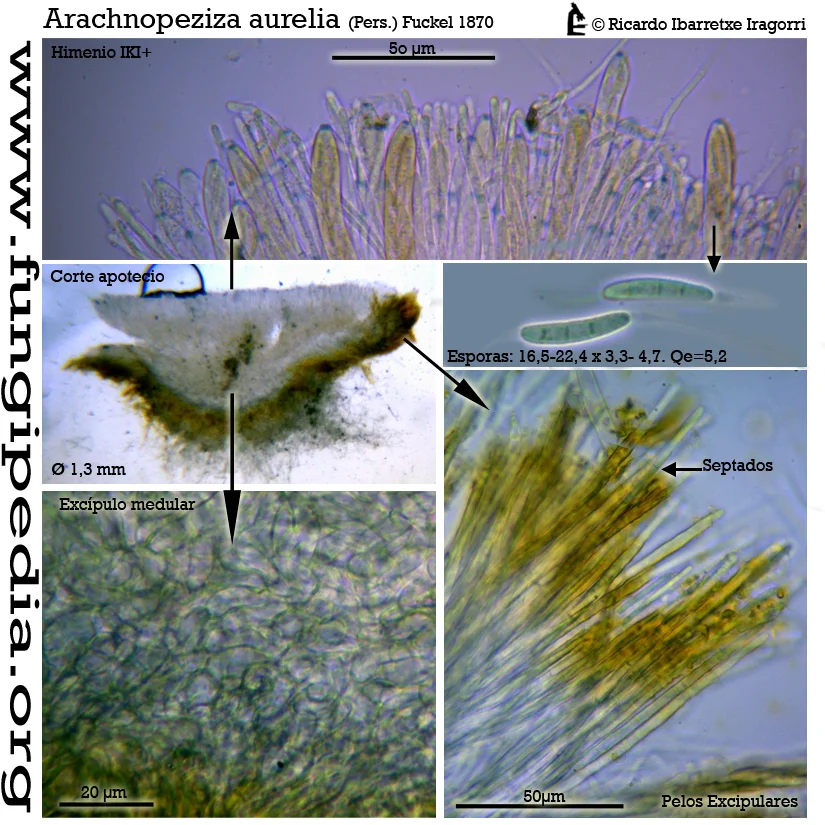
Arachnopeziza aurelia
Taxonomy
Main synonym
Common names
Peziza dorada
Geographic references:
Interactive map with data from GBIF.





Morphological Features:
Carpophore arising from a white mycelium composed of interwoven filaments that often appear superficially on the substrate, resembling spider webs. Fruiting on a whitish or yellowish subiculum, its diameter usually does not exceed 2 mm, typically ranging between 0.5 and 1.5 mm. Initially closed cup-shaped, it gradually opens during development to assume a more or less cupulate form reminiscent of species in the genus Peziza. The exciple ranges in color from yellowish to bright orange and is entirely covered with small hairs that are either concolorous or even more striking; at the margin, these hairs are more prominent and developed, sometimes forming tufts.
Hymenium lining the inner surface of the apothecium, completely smooth and lacking the hairs present on the exciple; its color, depending on the degree of hydration of the specimen, may be yellow or more orange.
Stipe absent; this is a sessile species.
Flesh indistinct, matching the external coloration, with no distinctive odor or taste.
Habitat:
This is a predominantly saprotrophic species that grows on the wood of various dead trees, or on woody and plant debris in general. Due to its small size, it often goes unnoticed, but it is a widely reported and geographically widespread species. It most commonly appears in more or less numerous clusters and may fruit at any time of year if conditions are favorable. Our collection was made in spring on wood of Betula sp.
Observations:
A small saprotrophic ascomycete characterized by its striking coloration and the presence of abundant hairs on the exciple, which are much more evident at the margin. Due to its distinctive characteristics, it is difficult to confuse with other species, perhaps with a congener such as Arachnopeziza eriobasis, or with some yellow Lachnum species; however, these generally possess white hairs rather than yellow or bright orange ones.
Microscopy of Arachnopeziza aurelia