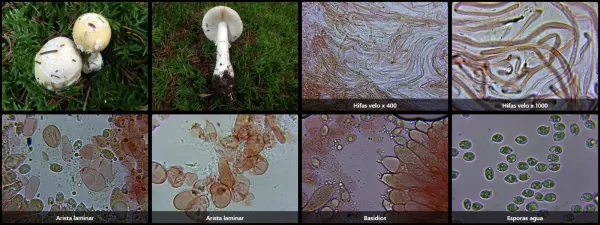

Amanita gemmata
Taxonomy
Main synonym
Common names
Lanperna hori.
Geographic references:
Interactive map with data from GBIF.



Morphological Features:
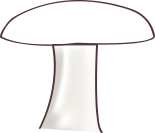
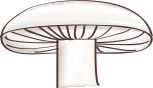
Pileus up to 5–10 cm in diameter at most; in most cases it does not reach this size. Initially globose at emergence, it expands to become first hemispherical, then convex, and finally plano-convex, without becoming fully plane. Its color is variable, giving rise to several varieties; yellowish-ochre in the typical species, with white veil remnants. The surface is shiny and viscid during rainy weather, smooth or striate at the margin.
Lamellae fairly crowded, white, adnate or even free with respect to the stipe.
Stipe central, thickened at the base into a bulb-like structure, in turn enveloped by a floccose volva that is highly variable in shape. It is white in color and bears a very fugacious ring; it is common to find specimens of this fungus lacking the ring.
Flesh white and tender, easily broken. It has a sweet, mild taste and an indistinct odor.
Habitat:
Fruiting in broadleaf forests, but preferably under various conifers, especially pines. It is most commonly found in late autumn, although it also appears in spring. It is very frequent and abundant in northern Iberia.
Observations:
Historically considered deadly poisonous, which it is not; subsequently regarded as harmless, which it also is not. It is definitively classified as toxic, which it is, though toxicity varies among individuals and varieties. It bears some resemblance to Amanita citrina, characterized by a lemon-yellow color and a potato-like odor, as well as to Amanita eliae, which is beige and more slender.