Amanita crocea
Taxonomy
Main synonym
Common names
Amanita enfundada, kukumelo laranja, pentinella.
Geographic references:
Interactive map with data from GBIF.





Morphological Features:
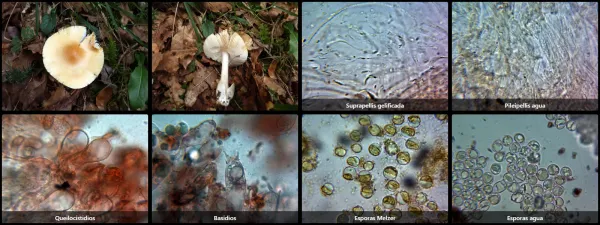
Pileus exceeding 10 cm in diameter, ovoid when young, then convex and finally expanded, retaining a small umbo at the center. The cuticle is smooth and striate at the margin, pale orange, tawny, or saffron in color, uniform, lacking volval remnants, and separable from the pileus.
Lamellae generally white, though sometimes with creamy or yellowish tints, not very crowded and interspersed with lamellulae. They are free from the stipe and the edge is floccose.
Stipe central and cylindrical, very long relative to the pileus, white in color; in the typical form it is finely covered with zigzag scales, while smooth in var. subnudipes. Frequently striate in the upper portion, completely lacking a ring, and its enveloping volva is white but somewhat creamy internally.
Flesh white and fragile, thin, with a faint odor and mild taste.
Habitat:
A fungus commonly found in deciduous woodlands, much rarer under conifers. Summer and autumn.
Observations:
It is a choice edible; however, it must be cooked beforehand as it is toxic when raw. It closely resembles Amanita fulva, which has a smooth stipe and a more conspicuous reddish-brown pileus. Both belong to section Amanitopsis, comprising species lacking an annulus.