
Amanita ceciliae
Taxonomy
Main synonym
Common names
Kukumelo ezkatagris.
Geographic references:
Interactive map with data from GBIF.





Morphological Features:
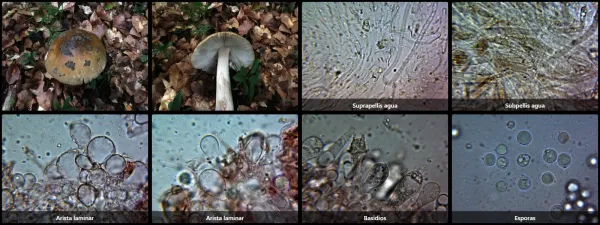
Pileus of good size, some specimens reach 15 cm in diameter, hemispherical in its early stage, then convex, and finally flattened, but retaining a characteristic obtuse umbo in its central area. Its color is variable, ranging from olive-brown to grayish-brown or even with tawny tones. The surface is adorned with grayish remnants of the universal veil, and the margin is strongly striate.
Lamellae rather crowded, white when young, becoming somewhat cream-colored with age. They are free from the stipe.
Stipe generally elongated and slender, grayish-white in color and adorned with darker, even brownish scales. It lacks an annulus, and its floccose volva extends upward along the stipe as dark grayish ridges. The base is bulbous and becomes hollow relatively early, despite being solid initially.
Flesh rather fragile and scant despite the robust stature of the fruitbody, gray in color. The taste is sweet and mild, and the odor is faint.
Habitat:
Normally fruits under broadleaf trees, with appearances under conifers being rarer. Fruiting occurs in summer and early autumn. It is not a very frequent or abundant species.
Observations:
Like the other Amanita species in the Amanitopsis group, it is edible after cooking, as it may be toxic when raw. We believe it is well distinguished from other fruitbodies in its group by the broad, grayish veil remnants on the pileus, its more brownish coloration, and its stature, which resembles that of Amanita porphyria, a species that does not belong to this group due to the presence of an annulus.