Amanita caesarea
Taxonomy
Main synonym
Common names
Oronja, kuleto, yema de huevo, ou de reig.
Geographic references:
Interactive map with data from GBIF.





Morphological Features:
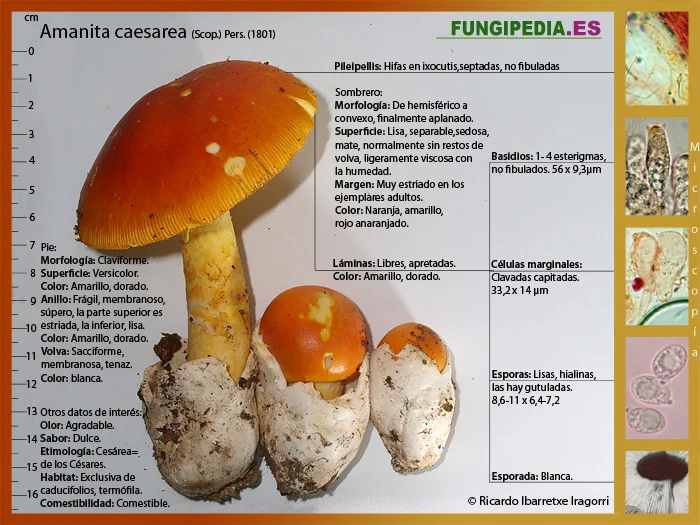
Pileus fleshy, capable of exceeding 15 cm in diameter, with a striking bright orange color. Cuticle smooth and separable, rarely bearing remnants of the veil. Shape transitions from hemispherical to convex, finally becoming flattened at maturity.
Lamellae of a beautiful golden yellow, generally with a fimbriate margin and quite crowded.
Stipe golden yellow in color, 2 to 3 cm thick and over 10 cm long, usually covered with a cottony-textured substance. Bears a persistent, striate ring of the same color as the stipe, along with an enveloping, membranous volva that is white and contrasts markedly with the rest of the fruit body.
Flesh with a sweet taste and pleasant odor. Fundamentally yellowish in color, becoming more pronounced upon cooking. Rather tender and delicate.
Habitat:
This species is highly thermophilous, thus appearing primarily in summer and early autumn. Fruiting mainly under cork oaks, oaks, holm oaks, chestnuts, and occasionally conifers. Abundant in Mediterranean climate regions; however, it is more difficult to locate in northern Iberia.
Observations:
A choice edible, considered by many the queen of mushrooms. Confusion may only arise from its resemblance to Amanita muscaria var. aureola, which however has a white stipe and lamellae. In Poland it is considered an extinct species; however, it remains frequent in southern Europe.

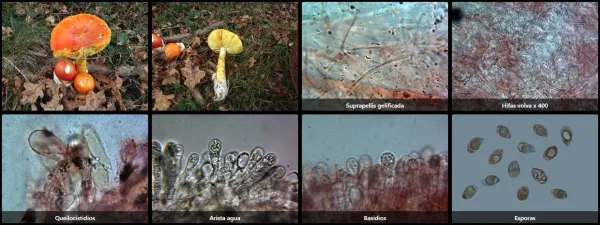
Microscopy of Amanita caesarea