

Entoloma sericellum
Taxonomy
Main synonym
Common names
Not available
Geographic references:
Interactive map with data from GBIF.




Morphological Features:
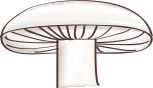
Pileus small; literature indicates it reaches up to 4 cm in diameter, however, we locate it every year and have never seen it exceed 2.5 cm in diameter. It is campanulate at emergence, but becomes hemispherical to convex and finally flattened, although sometimes, not always, it may bear a slight umbo. It is satin-white, glossy when wet, otherwise rather silky, and shortly after collection the central zone can be observed gradually turning yellowish. Margin regular and non-striate.
Lamellae adnate to slightly decurrent, white in color, fairly regular. Upon maturity they become pink due to the spore print, which is of that color.
Stipe elongated, generally twice the diameter of the pileus, bright white in color that stains yellowish upon handling. It is glistening, especially when wet. Central and cylindrical, slightly thickened at the base.
Flesh thin, scant, white in color, more fibrous in the stipe. Odor and taste are faint, mild.
Habitat:
The collected specimens were found in herbaceous areas, the typical habitat of the species, in this case along the edge of a track adjacent to a Pinus radiata forest. It is an autumnal species and rather rare, infrequent.
Observations:
It is a small-sized fungus that often goes unnoticed among the grass. It is sometimes confused by name with Entoloma sericeum, which however is completely different; only the names are similar. It is easily confused with Entoloma cephalotrichum, distinguishable by its capitate hairs and its habitat on moss, often adhering to tree bark.