
Albatrellopsis confluens
Taxonomy
Main synonym
Common names
Políporo confluente, Ardi-ziza laranjada, Sabatera confluent
Geographic references:
Interactive map with data from GBIF.



Morphological Features:
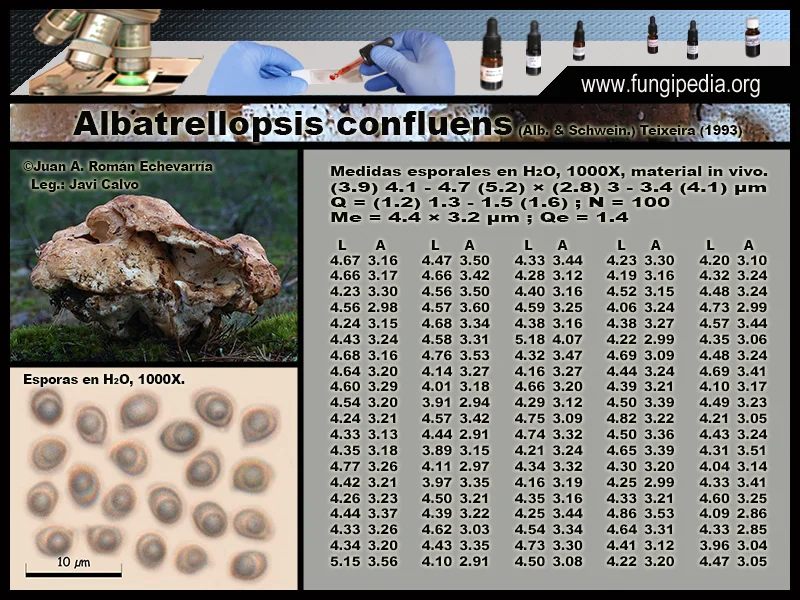
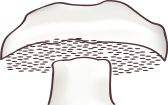
Pileus generally of considerable size; the diameter of developed specimens usually easily exceeds 10 cm. We have encountered specimens over 15 cm in diameter, and when growing in clusters, the total mass of confluent pilei sometimes approaches 40 cm. It is convex when young, becoming irregularly flattened and lobed at maturity, adapting its shape to adjacent pilei as it grows alongside them. The cuticle is a beautiful pale orange, which fades to white from the margin during rainy periods, whereas upon drying it becomes a more saturated pinkish-orange. The margin is involute for most of the growth period, fairly regular when young, tending to form lobes.
Tubes truly short, at best approaching 5 mm in length, white to creamy-white in color, occasionally slightly greenish, though this is usually due to algal contamination rather than the mushroom's own development. They may be adnate, but are predominantly somewhat decurrent on the stipe.
Pores very small, with 3 to 4 pores per mm of surface area, making them sometimes difficult to distinguish with the naked eye. They are the same color as the tubes.
Stipe cylindrical and typically short, shorter in centimeters than the pileus diameter, rarely exceeding 5 cm in height. It is quite thick, up to 3 cm, occasionally central but more commonly eccentric, often fused with the stipes of other specimens. It exhibits a satiny white color, very rarely showing any pinkish tinge.
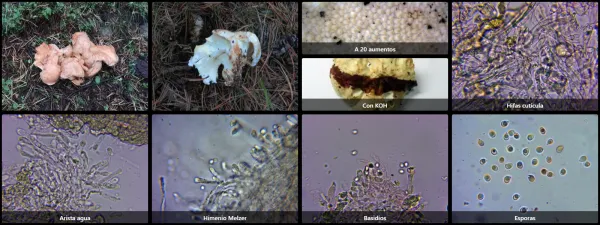
Flesh soft in young specimens but becoming hard and elastic with age, coriaceous in older ones. Whitish in color, it reacts purple with KOH. It has a mild, subtle yet pleasant odor, and a taste that turns bitter, more pronounced in older specimens.
Habitat:
Although isolated specimens occasionally appear, this species typically exhibits fasciculate or clustered growth of numerous confluent individuals, as its name suggests. It is considered a somewhat rare species worthy of protection, likely due to its highly localized distribution, although where it does occur, it often fruits profusely. It is fundamentally an early autumn species, sometimes appearing in late summer, fruiting in association with mountain conifers. Our collection was made in the Pinares Sur mycological reserve in Burgos, within pine forests containing Pinus sylvestris and Pinus pinaster, during October and November, where hundreds of specimens of the species were observed.
Observations:
This species is characterized by the orange tones of the pileus, the presence of short tubes and very small white pores, its fasciculate growth under conifers, and the reaction of its flesh to KOH. For all these reasons, it is difficult to confuse with other species; viewed from above, it might resemble Hydnum repandum, but turning it over quickly dispels this error upon confirming the presence of pores rather than spines. Among its congeners, Albatrellopsis ovina is a more greyish species with softer flesh that stains yellow; Laeticutis cristata, common in our beech forests, is greener and harder. However, undoubtedly the most similar species is Albatrellopsis subrubescens, which is macroscopically very similar but whose flesh reddens upon handling or cutting, especially on the stipe; its pileus is more whitish and develops brown or violet scales with maturity.
Microscopy of Albatrellopsis confluens