Abortiporus biennis
Taxonomy
Main synonym
Common names
Poliporo bienal, lur-ardagai.
Geographic references:
Interactive map with data from GBIF.




Morphological Features:
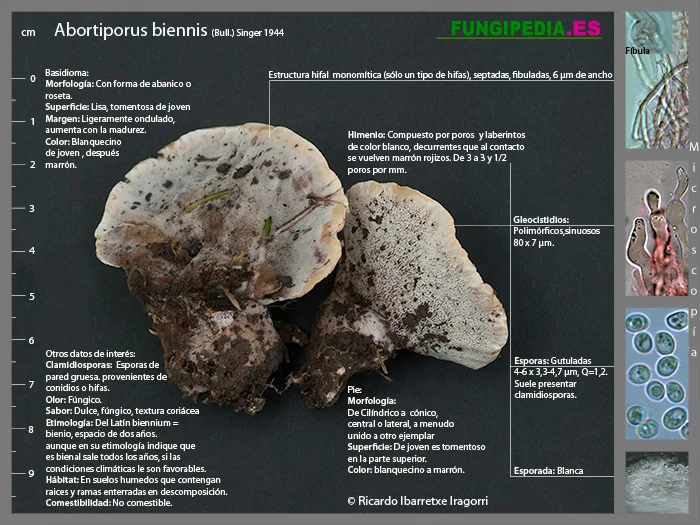
Pileus initially somewhat amorphous at emergence, but gradually developing into a true cap shape, sometimes forming clusters of several imbricate caps and other times appearing as individual entities. When solitary, its size at full development can range from 3 to 7 cm, although fused caps may form much more extensive masses. The color may be white, but it very commonly exhibits pinkish tinges with a paler margin; when old, they darken considerably. The surface may become velvety, or rather tomentose, but is generally smooth, with a barely undulate margin.
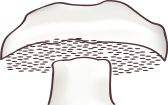
Hymenium composed of white, labyrinthine, denticulate pores, approximately 3 per mm. Over time, these become markedly lacerate, giving the hymenium an appearance different from its initial state. They are pale in color, nearly white, but stain reddish-brown upon handling. Decurrent onto the stipe when present.
Stipe may or may not be present; we have observed large rosettes without any trace of a stipe, however, when they apparently emerge from the soil on buried roots, they usually possess one. In such cases, it is typically lateral or eccentric, rarely central, and of a color similar to the rest of the basidiocarp.
Flesh not very thick and of a corky texture, whitish in color. Its odor is fungoid and its taste sweet.
Habitat:
This species fruits on decaying wood of various trees, as well as on old buried roots. It fruits in clusters, forming rosettes of numerous specimens or in a gregarious manner. It is quite common and appears mainly in late summer and throughout the autumn season.
Observations:
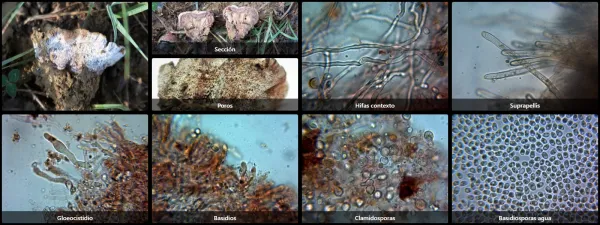
This species is characterized by its growth habit on old rotten stumps and in their vicinity on adjacent roots, as well as by its peculiar microscopic features, possessing chlamydospores and sinuous gleocystidia. Due to its labyrinthine pores, it may be confused with Daedalea quercina, which has thicker flesh and also thicker pore walls. It is a highly variable species, which has given rise to multiple forms or varieties.
Microscopy of Abortiporus biennis