

Tricholoma portentosum
(Fr.) Quél.
Study description
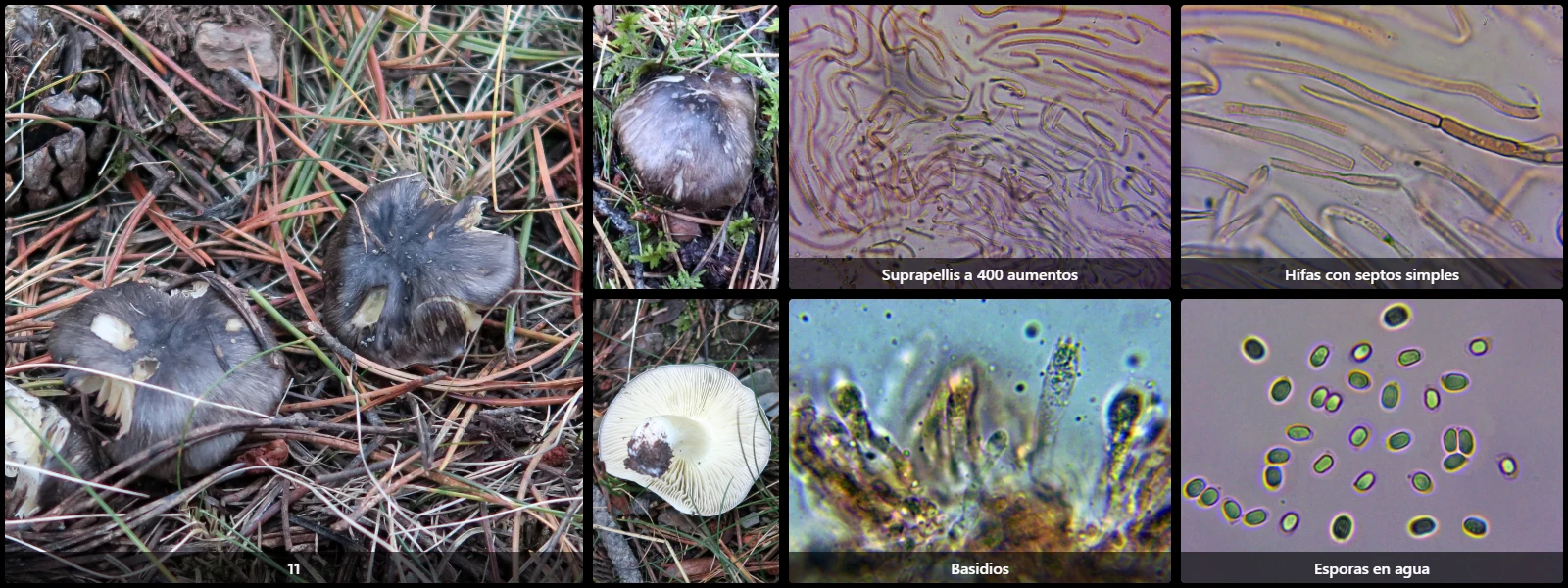
Species typical of coniferous forests, such as Pinus, Picea, or Abies, occasionally also occurring under beeches, with a convex to flattened cap, retaining an umbo in the center, 4 to 10 cm in diameter, with a surface bearing blackish radial fibrils over a greyish-brown background with yellowish tinges, adnate white gills, a cylindrical pale yellowish-brown stipe, and a mealy odour and taste.
Cuticle composed of filamentous hyphae arranged more or less parallel, those in the upper part widely separated from each other by gelification, with a greyish-brown intracellular pigment, 2 to 5 µm wide, and beneath these, more compacted hyphae, these more hyaline, 5 to 8 µm wide, all septate with simple septa (without clamp connections).
Without cystidia, although on the gill edge it may present some polymorphic marginal cells, with measurements similar to those of the basidia.
Lamellar trama regular or parallel.
Basidia clavate, 25 to 35 µm long by 6 to 9 µm wide, with a simple base and two or four sterigmata (bi- or tetrasporic).
Spores ellipsoidal, smooth, hyaline, thin-walled, with an eccentric apiculus at one end, 5 to 7 µm long by 3.5 to 4.5 µm wide, with a large oil drop occupying almost the entire spore, and inamyloid in Melzer's reagent.
Geographic references
Map generated from global occurrence data from GBIF. GBIF.
Study measurements
Values in Microns (µm)Macroscopic gallery
Microscopic gallery