Xerocomellus persicolor
(H.Engel, Klofac, H.Grünert & R.Grünert) F.Roqué
Study description
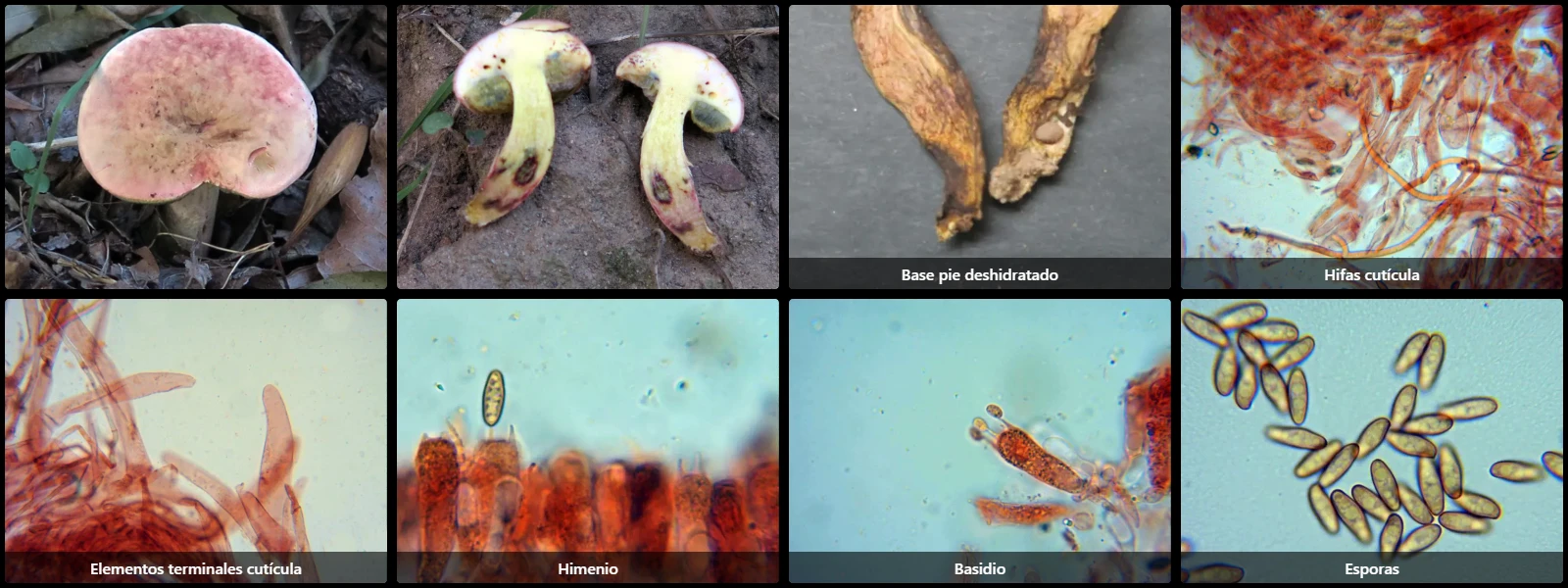
Species typical of broadleaf woodlands, especially oak or beech, with a hemispherical to convex pileus 4 to 8 cm in diameter, orange to reddish; pores and tubes lemon yellow to greenish yellow, blueing upon handling; odor and taste indistinct. A species very similar in all aspects to its congener Xerocomellus armeniacus (= Rheubarbariboletus armeniacus), differing in that the coloration of the flesh at the stipe base persists upon drying in Xerocomellus persicolor, unlike in Rheubarbariboletus armeniacus where this coloration fades.
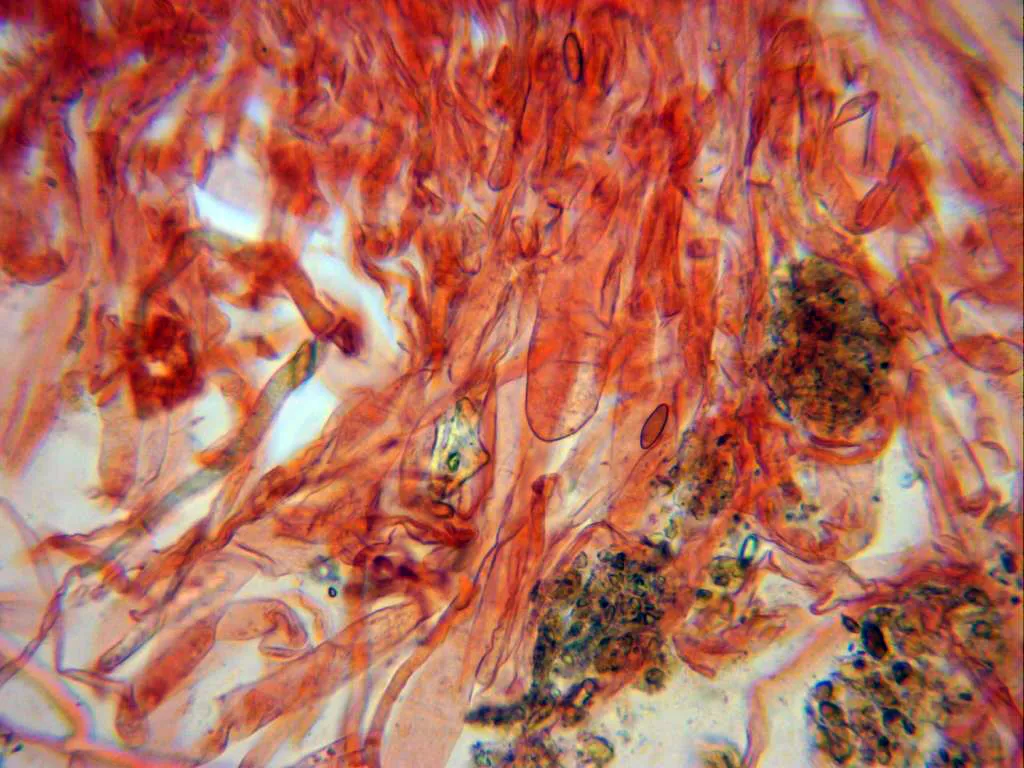
Cuticle filamentous, with cylindrical hyphae arranged more or less parallel, 5 to 10 µm wide, with yellowish-brown intracellular pigment, terminal elements cylindrical to fusiform, 6 to 12 µm wide, septate and without clamp connections.
Cheilocystidia not observed; according to literature, fusiform to lageniform, 25 to 40 µm long, 5 to 10 µm wide, simple-based.
Pleurocystidia scarce, with morphology and measurements very similar to cheilocystidia.
Basidia clavate, 35 to 45 µm long, 11 to 13 µm wide, containing granular content of small refringent oil droplets inside, simple-based and four-spored.
Spores cylindrical to fusiform, smooth- and thick-walled, yellowish brown under the microscope, with a slightly pointed end bearing a very discreet apiculus, 11 to 16 µm long, 4.5 to 5.5 µm wide, with faint oil droplet content inside.
Geographic references
Map generated from global occurrence data from GBIF. GBIF.
Study measurements
Values in Microns (µm)Macroscopic gallery
Microscopic gallery