Pyronema domesticum
(Sowerby) Sacc.
Study description
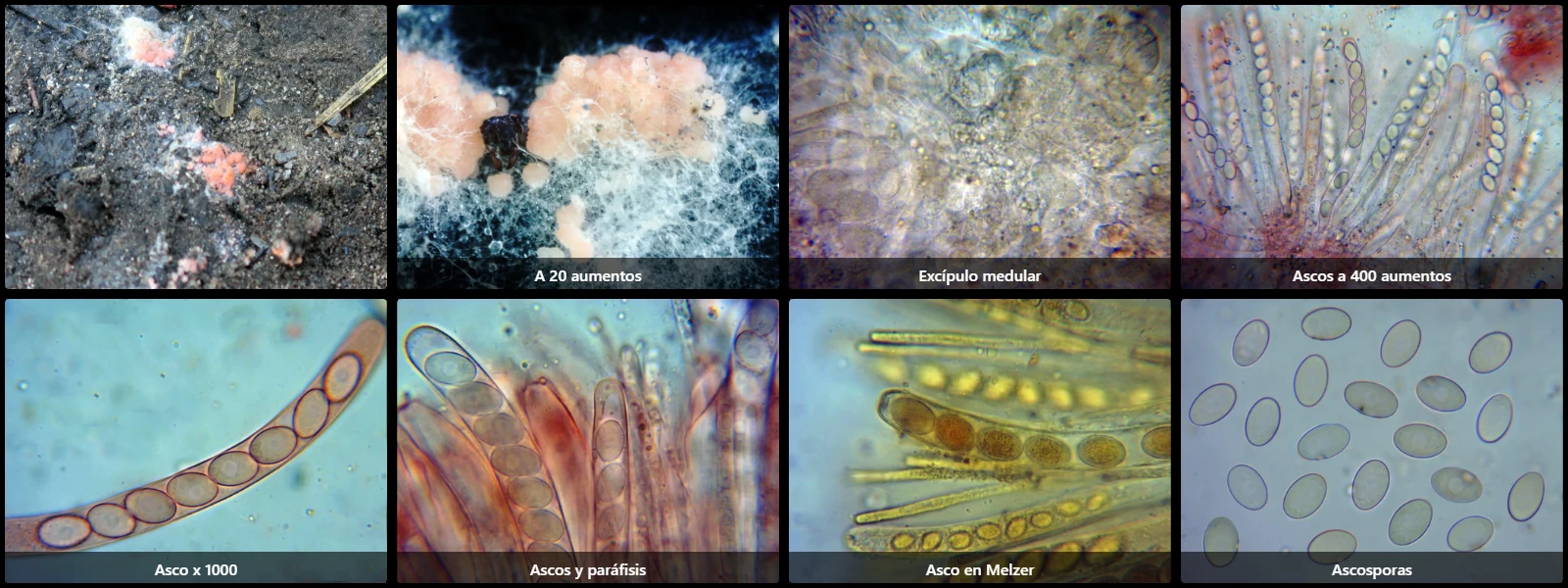
A pyrophilous species found on burnt ground, fire pits, or charcoal sites, with orange ascomata with pinkish hues, 0.5 to 1.6 mm across, coalescent and crowded into dense colonies seated upon a whitish, thread-like mycelial subiculum.
Hyphae constituting the subiculum filamentous, hyaline, septate, branching, 4 to 8 µm wide.
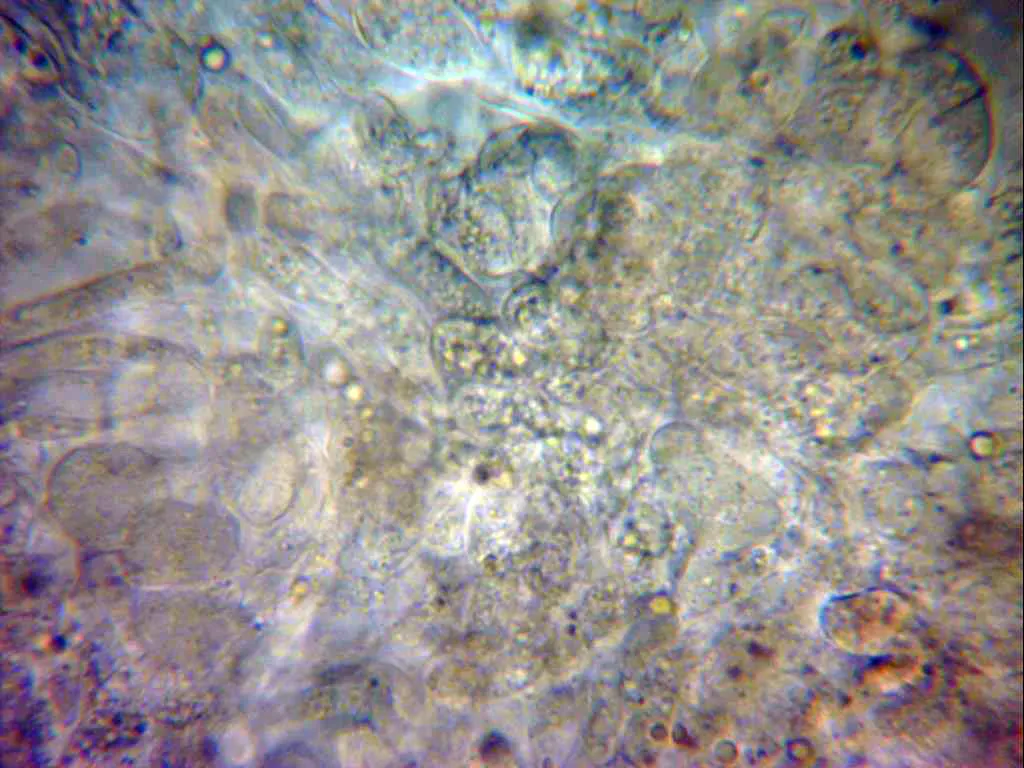
Medullary excipulum formed by globose to polyhedral hyaline, thin-walled hyphae 15 to 40 µm in diameter, decreasing in size towards the exterior (ectal excipulum).
Asci cylindrical, 8-spored, 130 to 200 µm long, 11 to 14 µm wide, uniseriate, occupying only the upper part of the ascus, inamyloid in Melzer's reagent.
Paraphyses filiform, septate, with a slightly enlarged apex up to 3 to 6 µm wide, containing abundant orange granulations inside, scarcely or not protruding beyond the asci.
Ascospores ellipsoidal, smooth, hyaline or with faint greyish intracellular pigment, thin-walled, 14 to 16.5 µm long, 9.5 to 10.5 µm wide, with a smooth and homogeneous interior (without guttules or vacuoles).
Very similar to its congener Pyronema omphalodes, which has narrower spores (6.5 to 8.5 µm wide).
Geographic references
Map generated from global occurrence data from GBIF. GBIF.
Study measurements
Values in Microns (µm)Macroscopic gallery
Microscopic gallery