Puccinia phragmitis
(Schumach.) Tul.
Study description
A parasite that requires two hosts to complete its life cycle: the aecial stage attacks living leaves of Rumex sp. (this study corresponds indistinctly to two collections, one on Rumex crispus and another on Rumex obtusifolius); the telial stage develops on Phragmites australis.
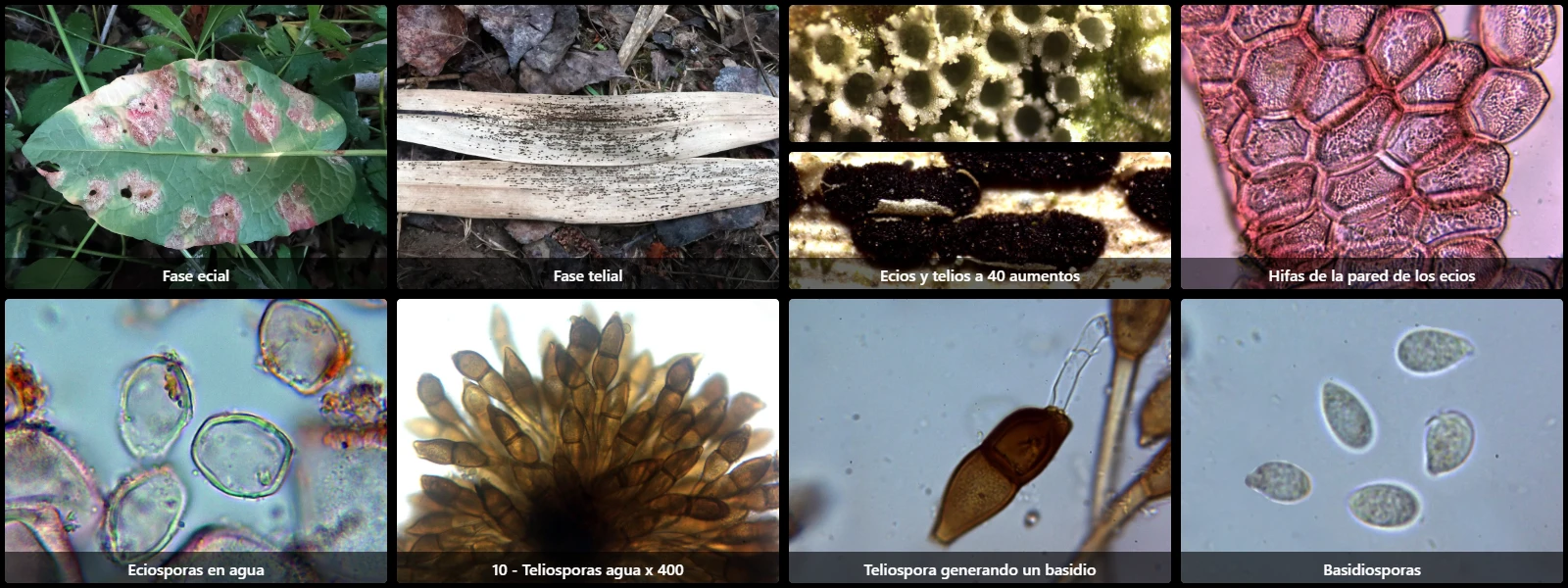
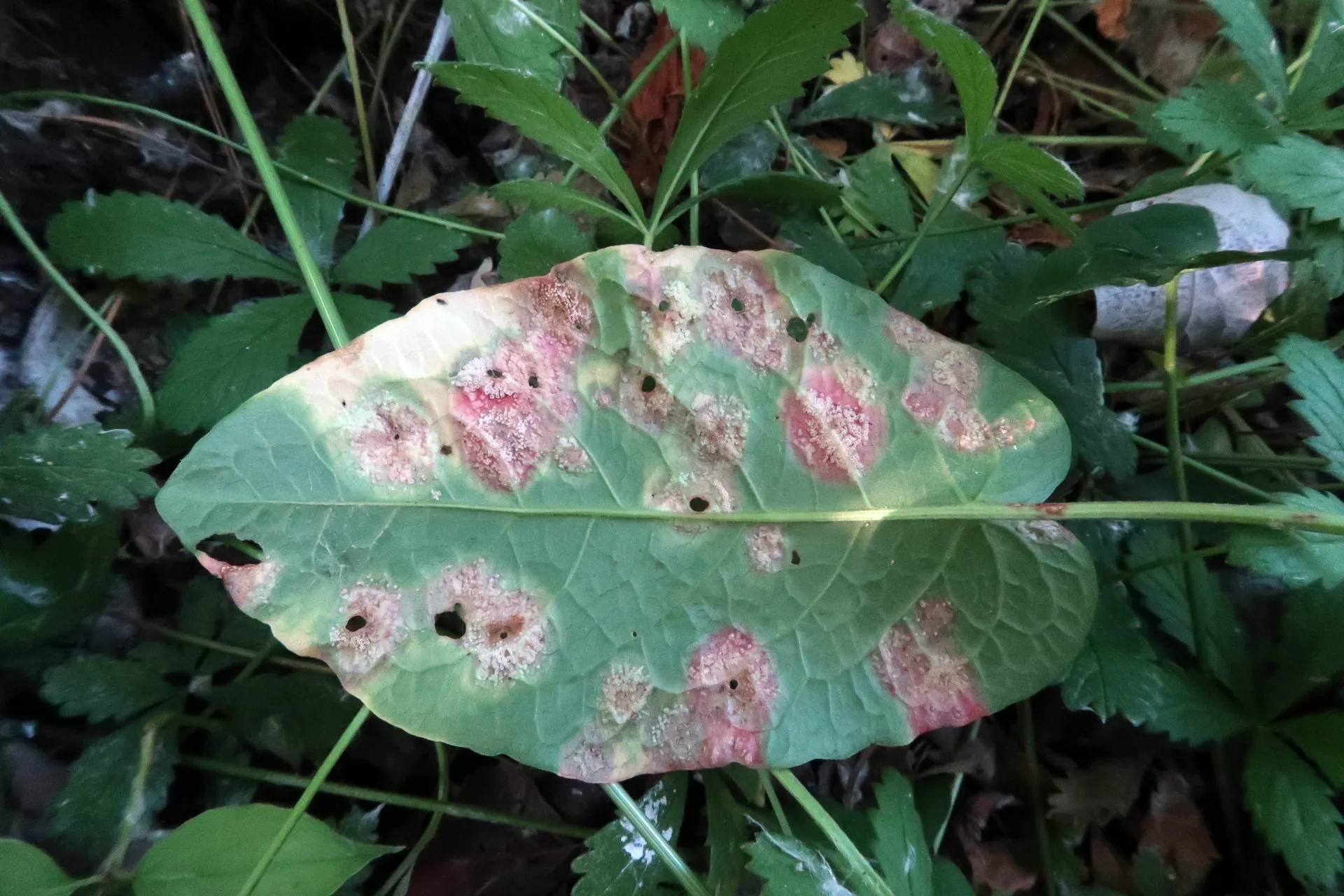
Aecia causing intense red to purple necrotic spots on the upper leaf surface, with numerous specimens clustering on the underside; these cup-shaped aecia are 0.4 to 0.5 mm in diameter, with a strongly raised, lacerate white margin and a whitish interior.
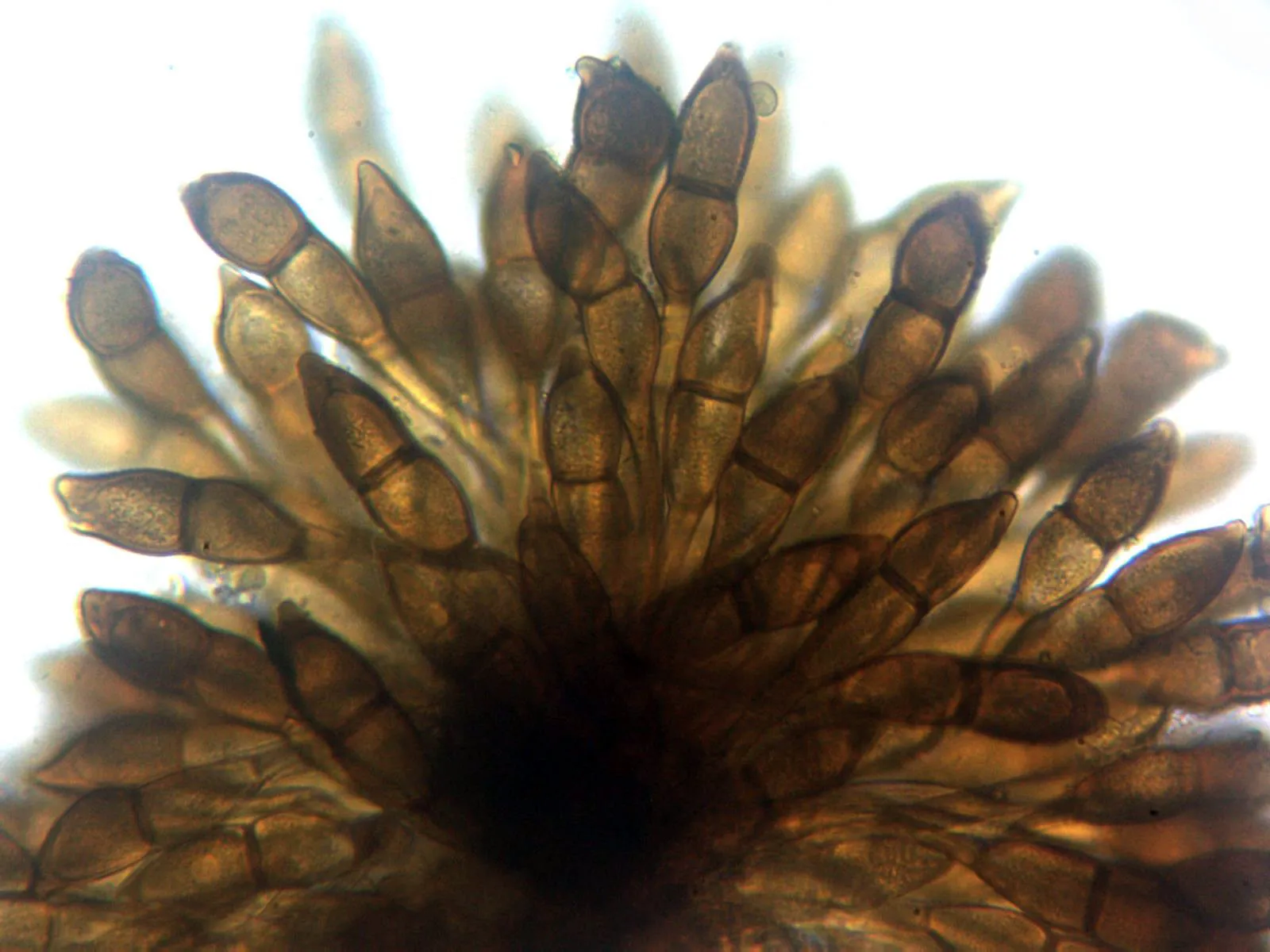
Telia producing elongated and compact powdery crusts, very dark brown to black, powdery in appearance; during this stage the teliospores will generate basidia, which in turn produce basidiospores to complete the cycle.
Peridial hyphae of the aecia polygonal, 20 to 35 µm long, 13 to 25 µm wide, with a thick wall 4 to 6 µm wide.
Aeciospores spherical, subglobose to slightly angular, practically hyaline, 16 to 21 µm long, 15 to 20 µm wide, with a thick wall 2 to 4 µm thick.
Teliospores cylindrical to fusiform, two-celled, with a thick central septum, constricted at the septum, brown under the microscope, 45 to 65 µm long, 15 to 18.5 µm wide, thick-walled (wall thickness 2 to 3 µm), with apical thickenings of 4 to 7 µm, and a long hyaline pedicel 140 to 200 µm long.
Basidiospores ellipsoidal to amygdaliform, smooth, hyaline, thin-walled, 10 to 12 µm long and 6 to 7.5 µm wide.
Herbarium material available: JTP2433/25.
Geographic references
Map generated from global occurrence data from GBIF. GBIF.
Study measurements
Values in Microns (µm)Macroscopic gallery
Microscopic gallery