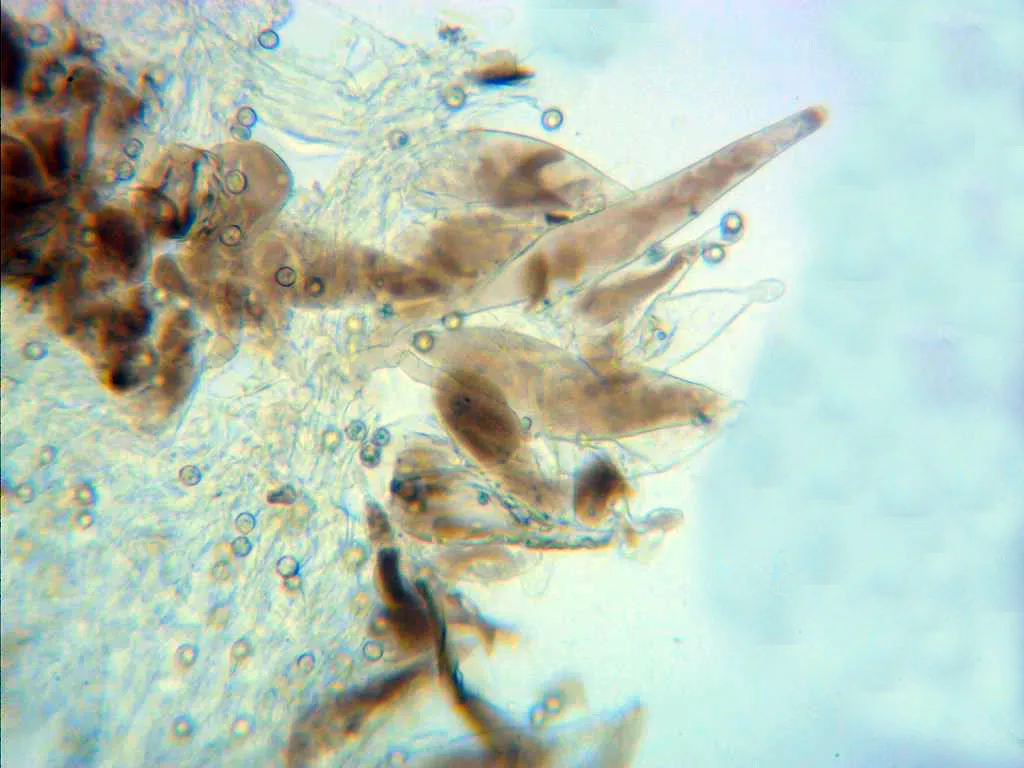
Pluteus exiguus
(Pat.) Sacc.
Study description
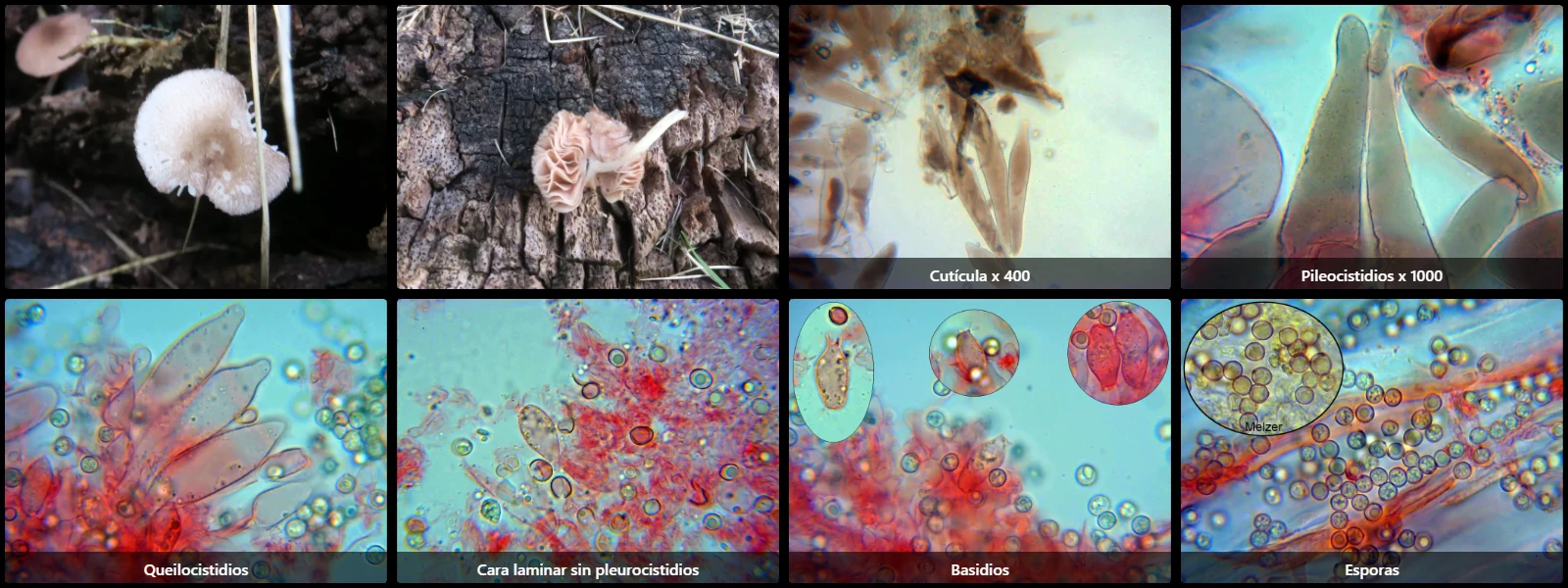
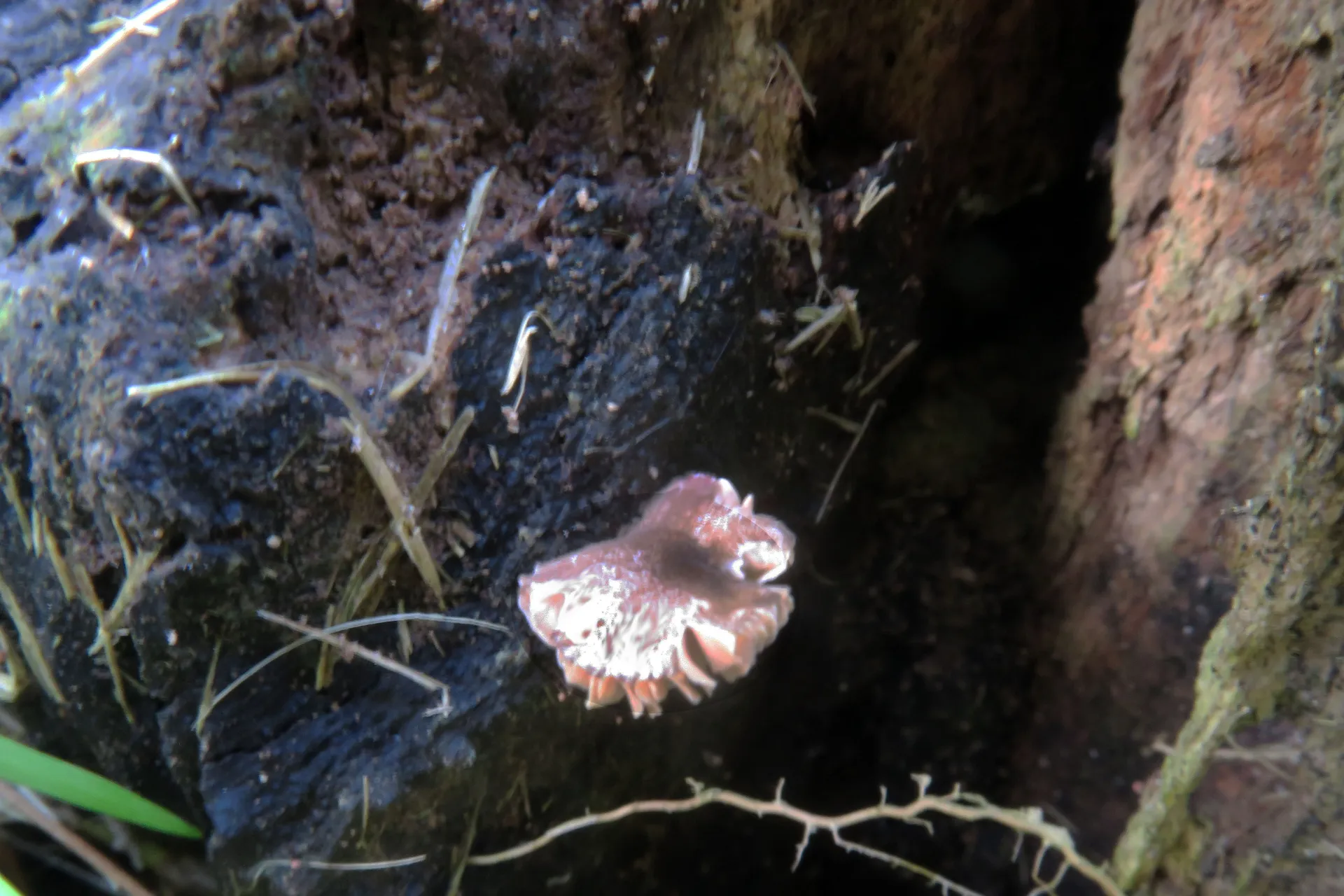
On decaying woody debris or woodchips on the ground, with a hemispherical to flattened pileus of small size (0.7 to 1.5 cm across), granulose to squamulose surface, brown to beige with an undulating margin, white lamellae rapidly turning pink from sporulation, a cylindrical, white, slightly hirsute stipe, without noticeable odour and slightly bitter taste.
Pileipellis composed of hyaline, more or less parallel hyphae, septate without clamps, surmounted by emergent terminal pileocystidia, cylindrical to fusiform, 80 to 150 µm long and 10 to 25 µm wide, filled with abundant brown intracellular pigment.
Cheilocystidia fusiform, slightly capitate, large, 35 to 80 µm long and 12 to 30 µm wide.
Pleurocystidia not observed; according to literature very rare and identical in morphology and size to cheilocystidia.
Basidia cylindrical, ventricose in the middle, 25 to 35 µm long, 11 to 13 µm wide, clampless at the base, 4-spored.
Spores subglobose to ellipsoidal, smooth, hyaline, slightly thick-walled, 5 to 7 µm long, 4.5 to 6 µm wide, with an indistinct apiculus, containing guttules, inamyloid in Melzer's reagent.
Geographic references
Map generated from global occurrence data from GBIF. GBIF.
Study measurements
Values in Microns (µm)Macroscopic gallery
Microscopic gallery