


Leucoagaricus barssii
(Zeller) Vellinga
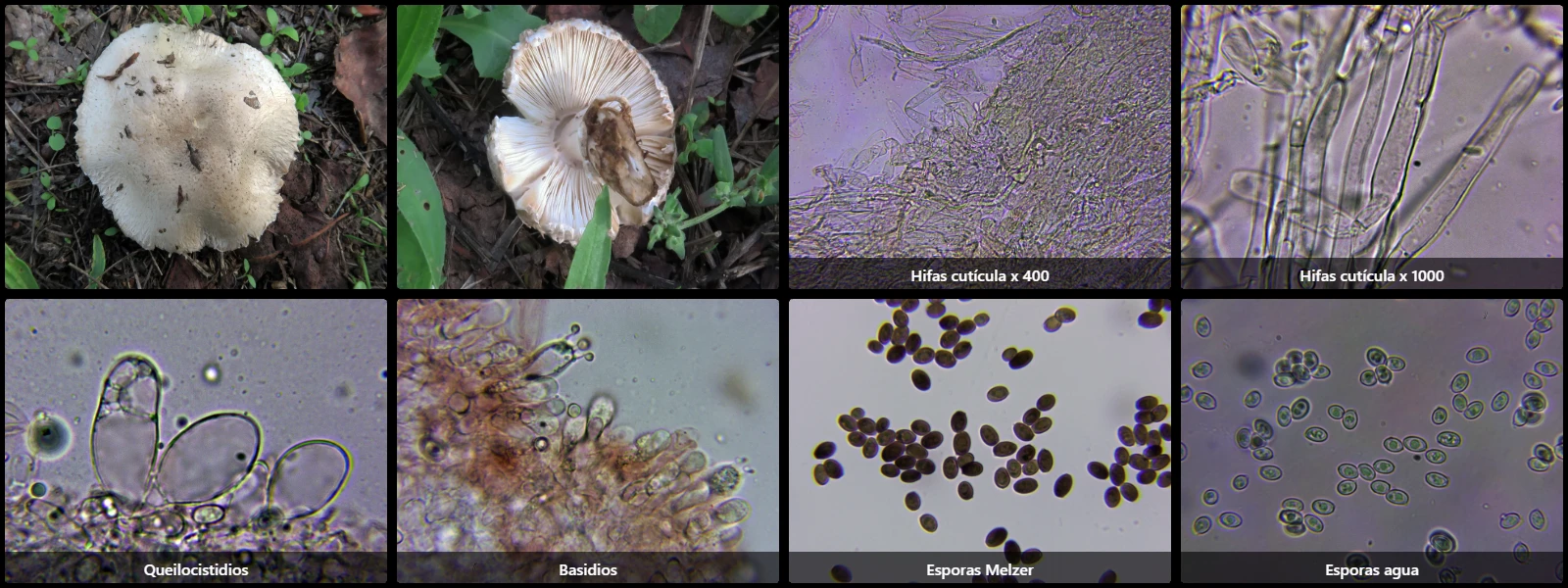
Study description
General: A lepiotoid species typical of sandy soils, featuring a fibrillose, uniformly grey convex pileus, a thin movable annulus, indistinct odor and taste, and white spore print.
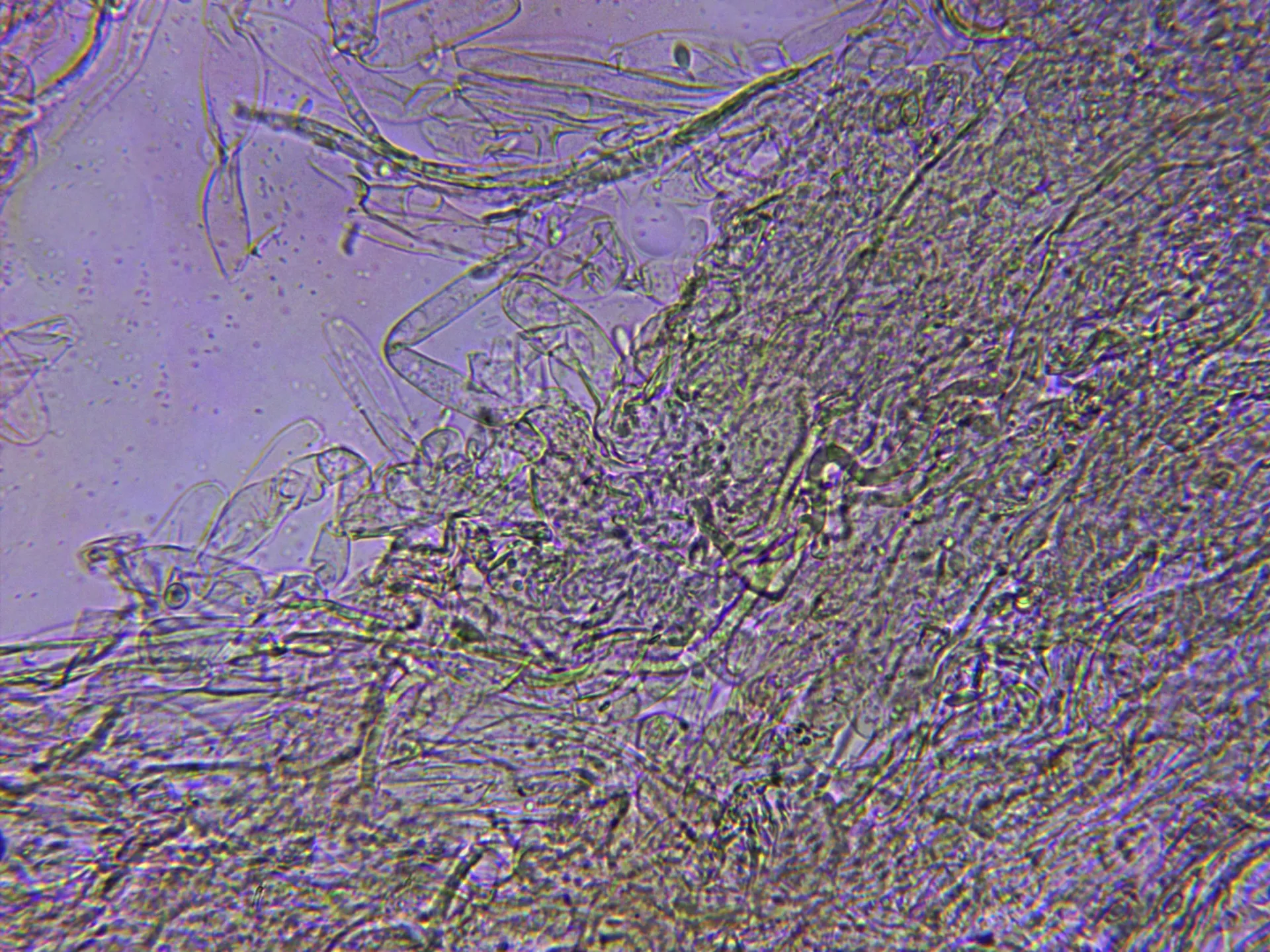
Pileipellis: Cutis composed of cylindrical hyphae 5-14 µm wide, arranged more or less parallel, with greyish-brown intracellular pigment, bearing abundant emergent terminal elements up to 110 x 7-18 µm, septate with simple septa (clamp connections absent).
Cheilocystidia: Very abundant, hyaline, thin-walled, polymorphous (clavate, pyriform, vesiculose, cylindrical), 25-80 x 8-25 µm.
Pleurocystidia: Not observed.
Basidia: Clavate, 18-40 x 7-10 µm, predominantly 4-spored with occasional 2-spored basidia.
Spores: Ellipsoid, smooth, hyaline, 6-8 x 4-5 µm, with a minute eccentric apiculus, strongly dextrinoid in Melzer's reagent.
Pileipellis: Cutis composed of cylindrical hyphae 5-14 µm wide, arranged more or less parallel, with greyish-brown intracellular pigment, bearing abundant emergent terminal elements up to 110 x 7-18 µm, septate with simple septa (clamp connections absent).
Cheilocystidia: Very abundant, hyaline, thin-walled, polymorphous (clavate, pyriform, vesiculose, cylindrical), 25-80 x 8-25 µm.
Pleurocystidia: Not observed.
Basidia: Clavate, 18-40 x 7-10 µm, predominantly 4-spored with occasional 2-spored basidia.
Spores: Ellipsoid, smooth, hyaline, 6-8 x 4-5 µm, with a minute eccentric apiculus, strongly dextrinoid in Melzer's reagent.
Geographic references
Map generated from global occurrence data from GBIF. GBIF.
Study measurements
Values in Microns (µm)Macroscopic gallery
1 / 7Leucoagaricus barssii - 1
Microscopic gallery
1 / 15Leucoagaricus barssii - 10 - Pileipellis x400