


Lepiota fuscovinacea
F.H.Møller & J.E.Lange
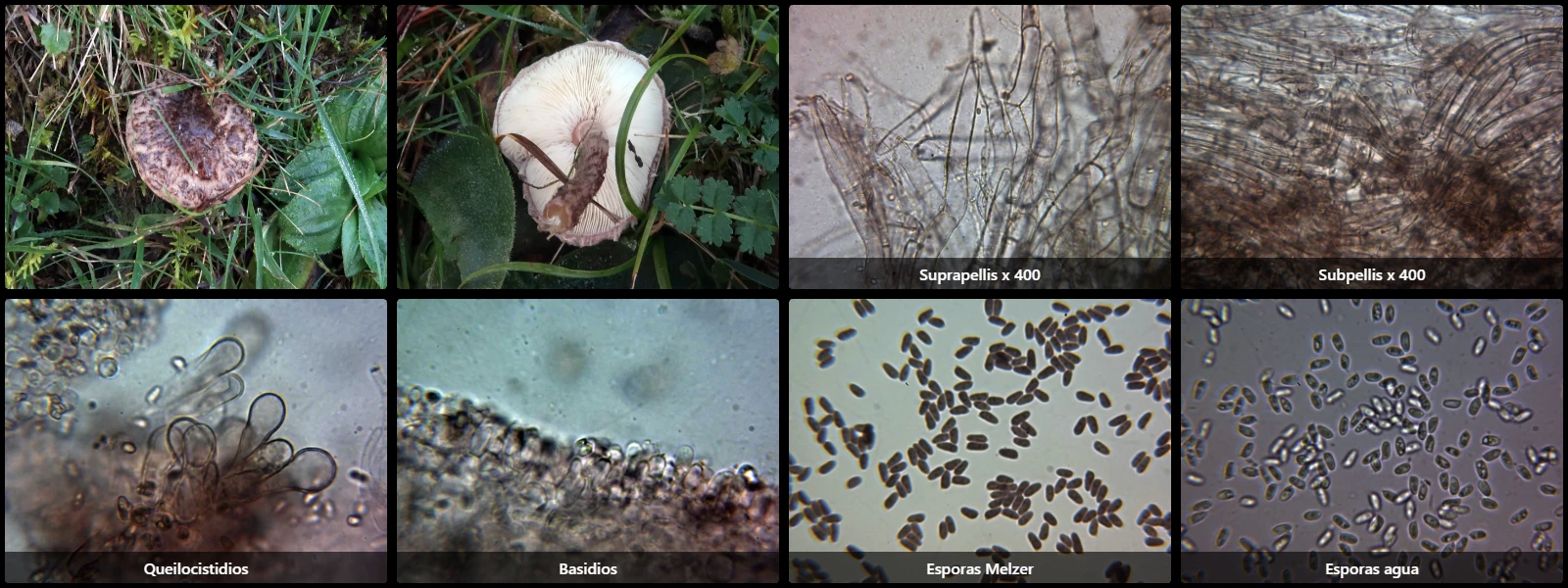
Study description
General: Occurring solitary along road verges or forest margins, pileus convex with dark vinaceous-red scales on a whitish-cream background, denser at the disc, unpleasant odor, mild taste, and spores small for the genus.
Pileipellis: Composed of cylindrical, prostrate to erect multiseptate hairs up to 500 µm or more long, terminal cells 50-150 x 10-22 µm, with abundant brown intracellular pigment, mostly with simple septa.
Cheilocystidia: Clavate to pyriform, hyaline, inconspicuous, 18-25 x 7-10 µm.
Pleurocystidia: Absent.
Basidia: Clavate, small, 14-16 x 5-7 µm, base simple, 4-spored.
Spores: Ellipsoid, smooth, hyaline, thin-walled, with an eccentric apiculus, guttulate, strongly dextrinoid in Melzer's reagent.
Pileipellis: Composed of cylindrical, prostrate to erect multiseptate hairs up to 500 µm or more long, terminal cells 50-150 x 10-22 µm, with abundant brown intracellular pigment, mostly with simple septa.
Cheilocystidia: Clavate to pyriform, hyaline, inconspicuous, 18-25 x 7-10 µm.
Pleurocystidia: Absent.
Basidia: Clavate, small, 14-16 x 5-7 µm, base simple, 4-spored.
Spores: Ellipsoid, smooth, hyaline, thin-walled, with an eccentric apiculus, guttulate, strongly dextrinoid in Melzer's reagent.
Geographic references
Map generated from global occurrence data from GBIF. GBIF.
Study measurements
Values in Microns (µm)Macroscopic gallery

1 / 5Lepiota fuscovinacea - 1
Microscopic gallery

1 / 20Lepiota fuscovinacea - 10 - Suprapellis x 400 2