


Lepiota clypeolaria
(Bull.) P.Kumm.
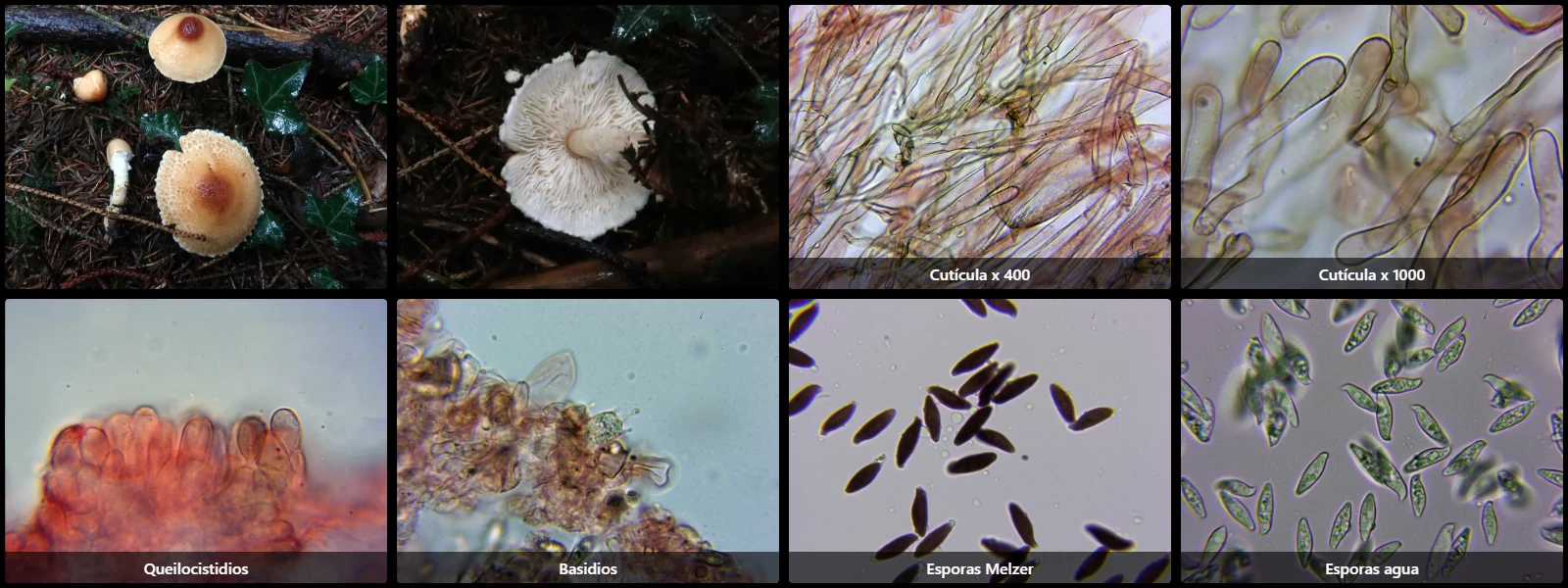
Study description
General: Associated with both conifers and deciduous trees on basic soils, pileus shaggy-scaly, darker at the disc, with a mild fungal odor and sweetish taste.
Pileipellis: Lined with abundant emergent hair-like terminal elements, 100-400 x 8-12 µm, containing pale brown intracellular pigment, septate and predominantly clamped.
Cheilocystidia: Clavate to vesiculose, 20-35 x 10-16 µm, hyaline.
Pleurocystidia: Not observed.
Basidia: Clavate, 35-45 x 10-13 µm, with basal clamp connections, 2- or 4-spored.
Spores: Ellipsoid to navicular/fusiform, smooth, hyaline, thin- to slightly thick-walled, with a curved lateral apiculus, containing oil droplets, dextrinoid in Melzer's reagent.
Pileipellis: Lined with abundant emergent hair-like terminal elements, 100-400 x 8-12 µm, containing pale brown intracellular pigment, septate and predominantly clamped.
Cheilocystidia: Clavate to vesiculose, 20-35 x 10-16 µm, hyaline.
Pleurocystidia: Not observed.
Basidia: Clavate, 35-45 x 10-13 µm, with basal clamp connections, 2- or 4-spored.
Spores: Ellipsoid to navicular/fusiform, smooth, hyaline, thin- to slightly thick-walled, with a curved lateral apiculus, containing oil droplets, dextrinoid in Melzer's reagent.
Geographic references
Map generated from global occurrence data from GBIF. GBIF.
Study measurements
Values in Microns (µm)Macroscopic gallery
1 / 7Lepiota clypeolaria - 1
Microscopic gallery

1 / 13Lepiota clypeolaria - 10 - Cutícula x 400 2