Hohenbuehelia nigra
(Schwein.) Singer
Study description
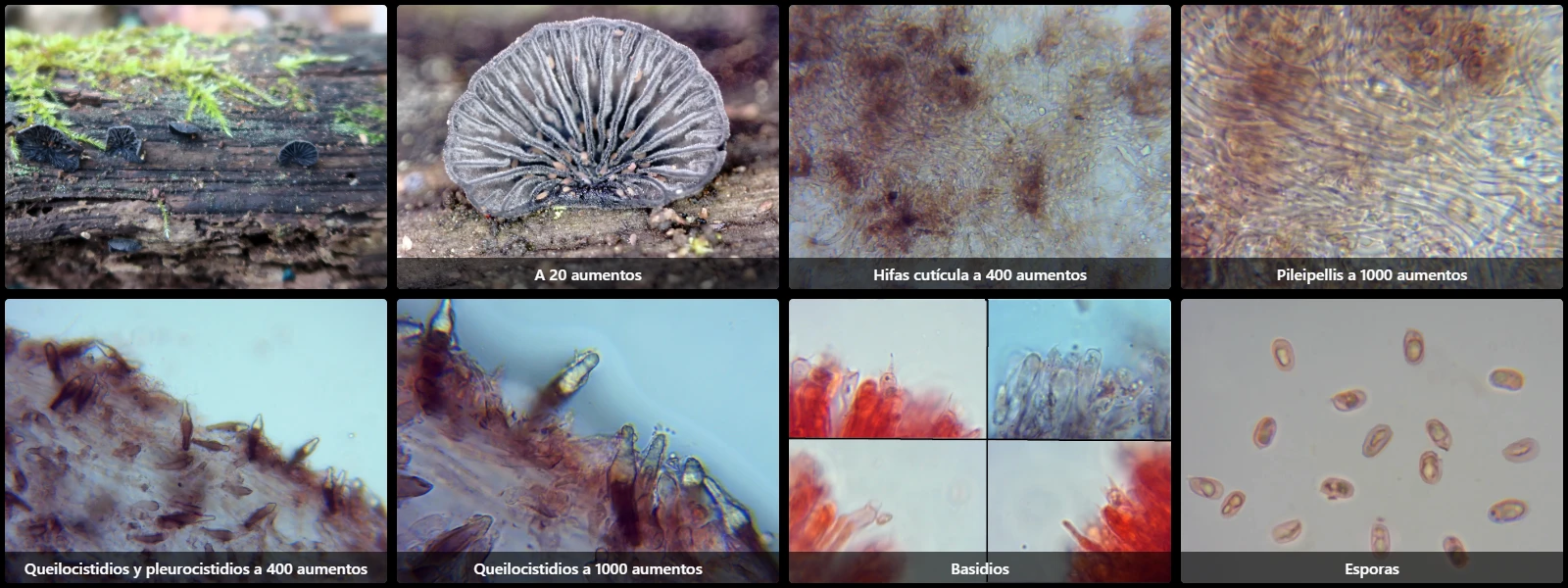
A species transferred in 2018 to the genus Resupinatus—a decision I personally found incomprehensible given its typical Hohenbuehelia microscopy—now returned to its former name; with a shell-shaped pileus attached dorsally, sessile, stemless, 5 to 12 mm in diameter; lamellae dark bluish grey; flesh scarce, gelatinous, without distinct odor and with a rancid taste.
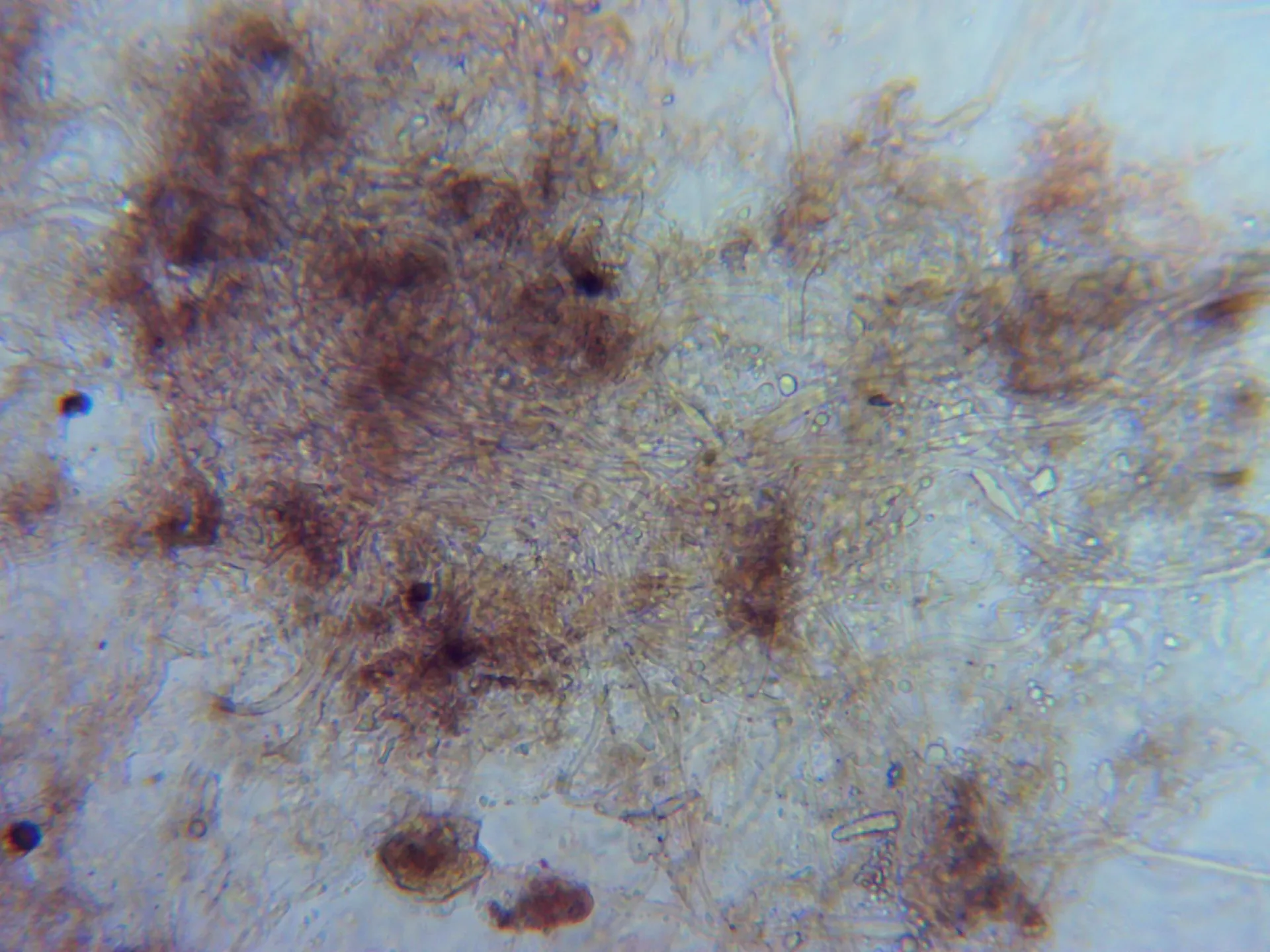
Cuticle composed of filamentous hyphae, with a gelatinous layer of interwoven hyphae 1.5 to 3 µm thick separated by gelification; beneath these, more compacted hyphae 3 to 5 µm thick with greyish-brown intracellular pigment; septate and clamped in both layers.
Cheilocystidia and pleurocystidia metuloid, abundant, fusiform to lageniform, thick-walled (walls 1 to 3 µm thick), reddish brown, 30 to 75 µm long, 6 to 12 µm wide, covered over their upper two-thirds with numerous crystals, intermixed with scattered leptocystidia with an elongated neck.
Basidia clavate, 25 to 35 µm long, 6 to 8 µm wide, with sterigmata up to 5 µm, basal clamp connections and four-spored.
Spores ellipsoidal, smooth, hyaline, thin-walled, 6.5 to 9 µm long, 3.5 to 5 µm wide, with an eccentric apiculus at one end, containing oil droplets of varying size inside, and inamyloid in Melzer's reagent.
Geographic references
Map generated from global occurrence data from GBIF. GBIF.
Study measurements
Values in Microns (µm)Macroscopic gallery
Microscopic gallery